02 June 2020

Black Lives Matter and De-Escalation

I generally try to keep this blog politically neutral. In practice, I'm pretty middle-of-the-road: fiscally more conservative, socially liberal. I firmly believe that everyone is entitled to their opinion and the overwhelming majority of the time, people with views opposing yours are not evil or ill-intentioned. Despite my admittedly abrasive-at-times personality, I've had many deep conversations with people who disagree with me about the "no no issues" (politics, abortion, gun rights, welfare programs, etc.). I like to understand where people are coming from, because it's rarely irrational. My mind can be changed. My opinions are not set in stone.

That said.

I cannot put into words how horrified and angry I am with the circumstances that created and the government response to the Black Lives Matter movement and protests over the killing of George Floyd. 

I refuse to believe that all police disagree with the BLM protests. I refuse to believe that the majority of police want to harm protesters. I refuse to believe that targeting protestors and journalists adheres to the interpretation of "protect and serve" by most police. It's much more likely that everyone is scared. Fear is a powerful thing. Someone gets nervous and overreacts, bumps the trigger, trips and pushes someone. It takes next to nothing for crowd mentality to take over and the situation to escalate. A small spark that sets off an inferno.

That said.

I'm sick of hearing people make apologies for the terrible behavior and reprehensible choices by those who are supposed to make us feel safe. I'm not going to argue that all police behave that way, because you and I both know that they don't. But as a country, there is a failure to provide law enforcement officers with tools to respond in a non-violent or non-aggressive manner. Sure, de-escalation tactics are taught at police academies, but in general, the majority of recruits only get around 8 hours of de-escalation training, compared to over 100 hours of firearms and tactical training. Most states don't require de-escalation training, or if they do, it's woefully inadequate (the average appears to be around 1 hour a year).

When police and other law enforcement officers react aggressively when they feel threatened or pressured, they are doing exactly what they've been trained to do.

This is, by definition, a systemic problem.
----------------------------------------------------------------------

An aside:
Malcom Gladwell's book "Talking to Strangers" is a riveting and disturbing look at why situations escalate. He neither accuses or apologises for the police involved in the altercations that lead to the death of unarmed people of color. Instead, he looks at the establishment and training that lead them to believe that aggressive responses are the solution. It's a great read, if a bit uncomfortable, and I highly recommend it.
----------------------------------------------------------------------

I am not trying to say that there are not malignant racists embedded in our justice system who use their position of authority to oppress minorities. I am not trying to excuse the law enforcement officers who find themselves in volatile, quickly evolving situations and chose to escalate or respond with disproportionate force. 

The trend of using disproportionate force on minorities because of a perceived threat is inexcusable and unacceptable.

Interesting (terrifying?) tidbit: There has been research (using numbers from 2014 and 2015) that indicates that police as a whole (not white police) are disproportionately likely to kill people of color. The issue is not one of white cop versus person of color, but rather cop versus person of color. The numbers are grim: approximately 12% of the US population is black, but they account for 28% of people killed by police. Latinos are also killed at a rate higher than would be expected using population demographics alone, and, unsurprisingly, whites are less likely to be killed by police. Even accounting for racial disparities of crime, blacks are more likely to experience use of force by police, on the order of 3.6 times more likely than whites. 

The argument that police patrol areas because they are low-income and thus hotbeds of crime, therefore systemic racism isn't actually what's going on, is bullshit. Ghettos and low-income neighborhoods are a relic of segregation and racist policies that prevented blacks from living in "desirable" areas and holding many jobs. This creates an at-risk group that in turn gets trapped by socio-economic circumstances that make breaking out difficult, if not all but impossible. 

Yeah. Shit's gotta change. 

Our armed forces manage to exercise restraint and control in combat zones and not kill the people they detain. They are expected to act as the world's police (which is a rant for another time) and pull it off time after time. They adhere to the rules of engagement (I am aware that the rules of engagement are extremely limiting and do not apply to domestic law enforcement. My point is, it's perfectly possible to be subjected to high-pressure and dangerous situations and not kill anyone as a knee-jerk reaction).

Why do our police not do the same? Why are we not giving our law enforcement officers the training and tools and empowering them to protect themselves by backing down? 

We spend our childhoods being taught that violence isn't the answer. And then we enter the real world, where entire portions of our population live in fear when they see someone who's job is supposed to be to make them feel safer. Countless people who are taught a script at a young age, actions to take to reduce their chances of being arrested and minimize the chance of escalation by police. 

That. Is. Bullshit.

There is something wrong with our law enforcement when the gut reaction of the citizens is fear.
----------------------------------------------------------------------

In many countries, police are viewed as an asset, a friendly face, someone who you can ask for and is there to help. Ev and I witnessed this firsthand living in the Netherlands, where the police are trained in (and very good at) de-escalation. Many of them don't even carry firearms.

My point is, I know things can be better.

The Black Lives Matter movement has so many reasons to exist, to be outraged, to demand change and reform. To try to downplay that is to trivialise the experiences of hundreds of thousands of Americans. 
----------------------------------------------------------------------

The protests have escalated, but I can't say I'm as appalled as I might be at the looting and rioting. The police response has been... less than ideal. For God's sake, some of them (bad apples, I can only hope) are targeting journalists. This is, in every possible sense, unacceptable.

Freedom of the press, as well as the freedom to assemble and protest, are enshrined in the US Constitution. Very, very explicitly (unusual in that document, to be honest). Assaulting peaceful protesters is unconstitutional. Trying to stifle or intimidate the press is unconstitutional (recall my rant about freedom of the press). 

I guess what I'm trying to say is, black lives matter. All lives matter, but it is wilfully ignorant to try to brush off the Black Lives Matter movement as an overreaction or baseless. This country needs institutional change and leadership from the top, not a petulant child incapable of empathy or compromise. Black Lives Matter is the result of systemic and well-documented injustice and disparity. They are not alarmists. They are not irrational. They are not exaggerating.
----------------------------------------------------------------------

So please, please make sure you're registered to vote. Most states will let you request an absentee ballot, which means you can vote early (which you should do, because there will likely be unprecedented absentee voting this election cycle a la Covid). Change is possible, and we should push for it from as many angles as possible: Protest. Vote. Write and call your representatives. Speak out when you see discrimination or racism. Be a positive influence in the world. 

Because right now, with the unrest and uncertainty and volatility, the one thing we can't afford to be is silent.

23 May 2020

Virtual Races and Diabetes: Have I Mentioned that T1D is a Pain?

Way back in April, in a moment of... something... I succumbed to peer pressure (shocking, I know, and very out of character) and signed up for a virtual race with a couple friends. The Social Distance Run promised to be goofy enough to appeal to my tongue-in-cheek sensibilities and historic loathing of organised events. With the lure of dad jokes, a cool shirt, a medal, and the slightly terrifying prospect of an actual training plan, I agreed to run a half marathon.


At first glance of the training plan, I went "oh god, training plans. Barf." But since I'm not a quitter (most of the time), I sucked it up and mostly followed it. Two shorter runs, an intervals day (hills or track, but I hate tracks so only did hills), and a long run on the weekend. There was a strength and stability day in there, too, but after doing it twice and limping around like a cripple for a few days after, I decided to stick to the running and leave the "getting stronger" thing for other people.

Gotta say, I've fallen back in love with running. Daniel (of aforementioned peer pressure) did most of the long runs with me (at a socially appropriate distance, of course), which made for an awesome weekend tradition that I'm hoping to keep up after race day.


-------------------------------------------------------------------------------------------

I've been running for 10 years ish and was so goddamn sure that I had a handle on the diabetes and endurance running. I've talked in the past about my learning curve when I started running and how I'd managed to get things figured out. Welp, it turns out that when you haven't been doing long runs or high milage for a few years and are also, ya know, ageing, your body behaves differently. My diabetes didn't get the memo about behaving the way it did 6 years ago.

This virtual race thing coincided with my relatively new use of Tandem's Control IQ system. Initially, I was super pleased with Activity Mode. It impressed on shorter runs (2-3 miles) and hikes, and as long as I had minimal insulin on board and ate 15g of carbs before starting, it seemed promising and sustainable. When I wrote my review of Control IQ, I raved about it, noting that it was great for physical labor, hiking, and the runs I was doing at the time. 

Welp, fast forward two months and 150 miles and I need to amend my original review. It turns out, my 30-year-old body doesn't like to process sugars or carbs while exercising. Also, I get ultra-sensitive to insulin while running / doing aerobic exercise. Looking back, I always addressed this by carbo-loading and setting temporary basel rates, going into long runs with a high blood sugar, and no insulin corrections. Unfortunately, the Control IQ algorithm doesn't allow you to do this effectively, what with the auto-corrections to keep you in the target range and the inability to set temporary basal rates. 

As I followed my training plan (complete with the promised dad jokes) and upped my milage to 20-ish miles a week, I found myself constantly fighting hypos. I started messing around with my diet in an attempt to stave off the inevitable crash during long runs, joined a couple Facebook and reddit type 1 diabetic running groups, and trying different supplements and gels on the recommendations of other T1D runners. I even tried making my own gummies using UCAN powder (surprisingly easy), which seem to be pretty effective at postponing the BGL crash if I take them 45 minutes before a long run. Supplement with regular gummies and Huma gels, and I think I have the diet thing mostly sorted out. After much struggling and many hypos, I also stopped trying to make Control IQ work for runs farther than 3 miles and started turning it off so I could set a temporary basal rate. I'm definitely on a stats kick right now, tracking my BGL and carb intake throughout my runs.


A major problem for me is that, for some unknown reason (probably because it likes being contrary), my body does not seem to absorb sugars when I'm exercising. What this means in practice is that I start a run, begin trending low, treat with some fast-acting sugar, and nothing happens. I can take on 60g of sugar during a run and still maintain a gradual (or fast) downward trend until an hour or so after the run is over, at which point it all seems to absorb at once and I skyrocket back into normal range (sometimes I get high, but as long as I don't keep treating the low, I don't seem to rebound in an extreme fashion). Basically, my best outcome for a long run is to slow the decline enough that I'm finished before it gets dangerously low.

Have I mentioned how annoyed I am that my old method of "carb up, wait 30 min, then run" no longer works?

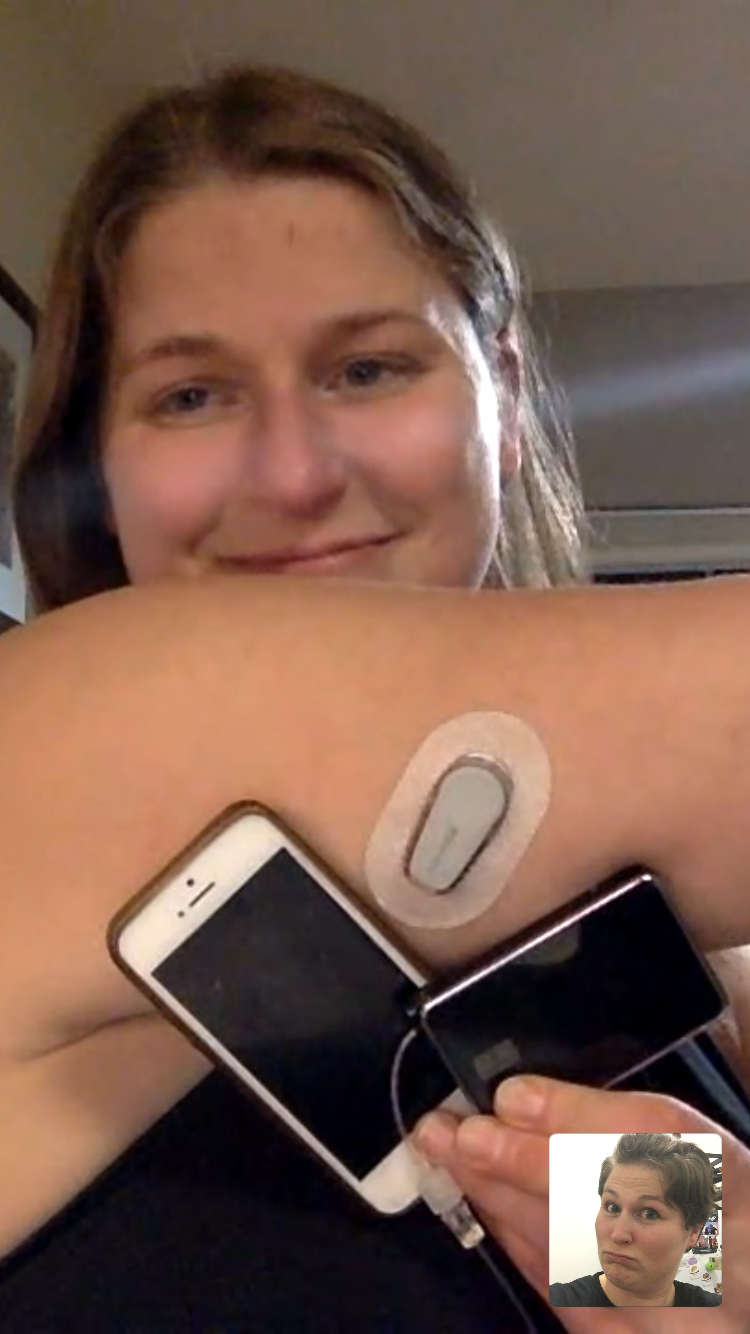
Further complicating matters is the fact that I've been having some pretty gnarly reactions to the Dexcom adhesive, making my CGM use a bit sporadic. I've been on the phone with Dexcom about this repeatedly, and they insist that nothing has changed in their adhesive or manufacturing. I call BS. The T1D running forums are full of people complaining about abruptly developing allergic reactions to the Dex adhesive and seeking ways to mitigate it. So far, I've tried Flonase and IV Prep to create a barrier (to no avail). This week I tried some Skin Tac barrier, but it's definitely not going to last the full 10 days; at this point, I'm hoping it stays on through my half marathon before the reaction bubbling under the adhesive rejects the CGM completely. The next attempt will be an actual adhesive barrier like Tegaderm, which I've been trying not to do because I have a history of reacting to similar products. I have photos of the reaction progression. They're not pretty. If you want to see them, I can show you, but let's spare unsuspecting eyes the trauma.
-------------------------------------------------------------------------------------------

Tomorrow is race day. I have a plan. The plan involves lots of complex carbs in the morning, a bunch of slow-release carbs during the run, and a beer at the end. Ev and I are aiming to meet Daniel around his halfway point (crazy guy's doing a marathon) and finish the run together at a brewery.


Let's be honest.... I'm really just in it for the beer.

-------------------------------------------------------------------------------------------
Update:
Half marathon on the books. And apparently, I finally got the diabetes part right (shocking, I know). Also, selfies while running (and dying) are super flattering.


04 May 2020

The Quarantine Diaries

Day 45

0530 My internal clock is telling me I should get up. You’re late for the climbing gym. You want to skip traffic. You have a ton of work to do and it’s easier to get it done before everyone else shows up at the office. I shut that shit down, steal the blanket back from my husband, and fall back asleep.

0655 The first alarm goes. I just fell all the way back asleep. Hard pass.

0710 The second alarm goes off. This time I roll out of bed and limp my way to the kitchen. This is why I prep coffee the night before. Hit the “go” button and then the bathroom. Cold face wash gets my eyes open, and working the ankles gets them actually mobilizing for the day.

0715 Coffee time. Also a yogurt. But mostly coffee. A decade of exposure to my cheerful morning ways keeps the husband from talking to me and it’s fantastic. 10/10 would recommend.

0745 Actually awake and approaching functional. I consider putting on real pants, and opt for yoga pants (again). Jeans are a relic of the past, but I try not to wear actual pajama pants during the day. Relocate from the kitchen island to the dining room table, aka my work station. If I think about it at all, I get annoyed that I’ve given up my dining room table to work from home. We’ve been eating in the kitchen, standing up, and on the floor or couch the last two months. 3/10 would not recommend.

0750 Log in, check emails and missed Teams messages. Grumble about how stupid this is. Start working on whatever nonsense I had going the day before.

0830 The daily department check-in meeting is such an adventure. We’re all keeping busy, and while this call always starts on-topic, we wind up discussing home buying, yard work, and how reports from people who have “recovered” from Covid are incredibly terrifying. I compare Covid to polio insofar as just because you survive doesn’t mean it doesn’t fuck up your life long-term. Surprisingly, nobody disagrees with me. We all agree that discussing it in terms of mortality and recovery rates alone doesn’t capture the actual magnitude of the pandemic. We’ve been in this meeting for 45 minutes and off topic for 20. We should probably go do the things we actually get paid for.

1000 The husband wanders out of his “office” (aka the gear room, home of the climbing gear, camping equipment, and general happiness. I think he got the better office space in our arrangement. I wonder if I can convince him to trade work stations?). We go on a walk to the coffee stand down the street. It’s a nice excuse to stand up and move around for 5 minutes. Also coffee. I should really build a shrine to it.

1010 Triple shot americano in hand, it’s back to work. Time to zone in and do… oh god, why is the model acting like this? These numbers don’t make sense… the math isn’t that complicated… maybe I’ll do a hand calc just to compare. Wait, I’ve already done hand calcs. Okay, I guess I’ll update it to the specific modeling method. I swear I’ve been stuck in this loop for a week.

The model I’m working on looks like a penis. Has anyone else noticed this? How has nobody commented on how bloody phallic this geometry is. *snicker*

I think I know why the program is outputting different values. But I want someone to confirm. Tech support is lost and just sent me to an actual programmer. He’s lovely and looking in the back-end at equations and dependencies for me. I’m pretty sure I found a fairly important limitation (from a user-perspective) when constructing models, but I really want it confirmed. Have I mentioned I want confirmation of my hunch?

1300 How is it already afternoon? I should grab some food. Looks like leftovers. I’m down with that. Oh! Cookies! I like cookies.

1305 Back to the models. Maybe I’ll stop trying to figure out what’s going on and just use a simplified method. Less exact, more conservative, but at least I understand why it’s calculating things the way it is.

1400 The phone rings. Who even uses phones anymore? Isn’t that why we have Teams and email? There’s a metaphorical dumpster fire and they need me to design a retaining wall. “Do you have a couple hours to get on this?” Not really, but I suppose there isn’t anyone else, sooooooo…. “They need it designed by Wednesday. Have to get it submitted for permitting.” Alrighty then. I am a retaining wall ninja. I shall design this retaining wall using my extra-special Mathcad sheet. I went through it and updated it to highlight the user inputs, manual table updates, and check values a couple weeks ago. This will be a good test to see if I missed anything.

Ooooooh! How do other states have such well laid out design guides and standard drawings? This is making my life so much easier! I should get a Washington license and only work on jobs down there.

1600 It’s quitting time. Working through lunch is great. I love not working. I should probably finish this retaining wall design though…. It’s almost done. 5 more minutes.

1630 Time is a construct and I’m bad at managing it. Quitting time for real. Switch from the dining room office back to the kitchen island, open up the laptop, and dink around on the internet for a bit. Mmmmm internet. For some reason, I’m cranky. No reason to be, but I feel my mood deteriorating. I blame work and being stuck in the house.

1700 The husband is done with work. We discuss going for a run, but he needs half an hour to “decompress.” Fine. I can wait. The couch is calling.

1730 Run time. In a fit of stir-crazy, I signed up for a virtual race with a couple friends. It comes with a training plan. Being slightly compulsive, I’ve been trying to stick to it. I hate training plans, but I guess it keeps me motivated. I am now fully on edge and rapidly approaching stabby. According to the plan, it’s a 3 to 5 mile day. Fuck that noise, I want to sit on the couch and not wear pants and wallow in my crankiness.

Mile 1: This is stupid. I hate my job. I want to stab everyone.
Mile 2: I guess things are actually okay. I like being outside.
Mile 3: I suppose I also like my husband. I’m actually in pretty good shape these days… all this running around the neighborhood is good for my mileage.
Mile 4: Goddammit stupid diabetes. Blood sugar is tanking. The day is beautiful and I’m happy again, but also fuck everything cuz I’m low. I seriously need to reconsider my diet.

1900 Finally got the blood sugar level trending up. No idea what we’re doing for dinner. I hope that if I ignore it, the husband or sister will cook. We play a sad game of cooking chicken in this house. I often win.

2000 Consider showering but decide it’s too late and I don’t want to sleep on wet hair. This is a garbage excuse, since nobody sees me in this time of Covid. We turn on White Collar and zone out to the TV instead. Amazon Prime has surprisingly limited commercials. Also, Rachael Ray’s dog food commercial is making me homicidal. Nobody should be that perky. It plays every time there’s a break. Kill me now.

2200 Despite heckling from the couch, I call it a night and relocate to the bed. Not like I’m going to sleep or anything… I start off reading a couple chapters of “Sapiens” and then switch to a free trashy romance novel. Variety is the spice of life. Also, thinking keeps me up at night. I refer to romance novels as a “pallet cleanser”.  

2330 Unfortunately, the pallet cleanser is easy reading and I go through half the book before I feel tired. Did I read this much trash before social distancing? I should really go to sleep…

23 March 2020

Extra Fancy Toys: Tandem t:slim X2 with Control IQ and Dexcom G6

After much excitement (and anticipation), Tandem rolled out their fancy new hybrid closed-loop insulin pump - CGM system, aka Control-IQ. Obviously, I was super excited to try it out and wasted no time in getting my hands on it. 

I figured I'd give it a month or two to put it through its paces before writing a review. It's worth noting that aside from some minor interface changes (which improved the intuitiveness of the system), my original review of the t:slim x2 still applies.

--------------------------------------------------------------------------------

Closed Loop Systems

I'd like to take a moment to point out that Tandem works with Dexcom, who has been working with other insulin pumps (notably Omnipod) to make closed-loop systems available on a multitude of systems. This is a huge step for making diabetes management systems more widely available for people with pumps still under warranty or who don't want to switch systems. The big push for an FDA-approved loop system that allows diabetics to create a closed-loop system on a variety of insulin pumps and CGMs is being spearheaded by Tidepool, who is working with a multitude of manufacturers, including Dexcom, Omnipod, and a couple unnamed pump manufacturers (who I'm sure includes Tandem) to create an iOS-available closed-loop app. A short but worthwhile discussion on this and potential ramifications can be found here.

Also, in case you missed it, the Control IQ software is interoperable, meaning it's compatible with hardware from other manufacturers. Additionally, the Control IQ algorithm was approved by the FDA, rather than a stand-alone device like the Medtronic 670G. 


Control IQ vs. Medtronic 670G

Unsurprisingly, there are already well-written and fairly comprehensive comparisons between the two closed-loop systems on the market. Personally, I like this one (it's a little outdated, but the comparison between Control IQ and the 670G is on point). Another good, detailed comparison between the two systems can be found here.

The Control IQ system works by automatically adjusting your basal rate (aka background insulin) up or down to keep your BGL within a fixed target range. The algorithm uses the rate of rise or fall and amount of active insulin to determine when and how much to adjust the basal rate. Where Control IQ differs from Medtronic's 670G hybrid closed-loop system is that Control IQ delivers automatic-corrections if your BGL is predicted to rise above 180 mg/dL to increase your time in-range (for the record, the next generation Medtronic system will also deliver automatic corrections). This helps reduce highs if you forget to bolus for food. It also has two activity modes that adjust the target BGL range and auto-corrections: sleep mode and exercise mode. I'll get into those in more detail in a bit, cuz I'm super impressed with exercise mode.

The other significant (and I would argue more important) difference between the 670G and Control IQ is that the Dexcom G6 does not require any external calibrations, whereas the Guardian CGM requires calibration twice a day. As always, I'm a huge fan of having as few things to enter as possible to help reduce data entry error.

In case you were wondering, Control IQ is considered more aggressive than the 670G and has a higher time-in-range for users. 

--------------------------------------------------------------------------------

Getting Started

Feel the excitement!

One of the big selling points of Tandem is that software updates can be downloaded directly to the pump, rather than requiring a hardware trade-out. If you recall, I knew Control IQ was in the works when I switched to the t:slim last year, and the easy upgrade was a huge selling point. Tandem cut a deal with the FDA that allows t:slim users to do online training on Control IQ (rather than the traditional in-person training) to unlock a code in order to download the upgrade.

The online training is a couple hours of mostly intuitive stuff, and a detailed breakdown of how the Control IQ algorithm works. Pretty painless overall. Like my transition to the t:slim from my Medtronic pump, the system is intuitive and user-friendly. I continue to be impressed with the interface and durability of the t:slim, as well as the effectiveness of Tandem's customer support team.


By the way, you should definitely WATCH THE TRAINING VIDEOS! My sister, apparently, did not (I guess when you switch to Tandem they don't have a mechanism to force you to do the training videos before using the pump), and as we were discussing how she liked the system, many of the things she brought up were addressed in the videos. So apparently, the videos are good. Watch 'em. Tandem also offers in-person training, which I hear is also good. But, being an anti-social engineer-type, I'm all about not talking to a human if at all possible.

As you may have gathered from the previous paragraph, I recently convinced my sister to switch to the t:slim from her Medtronic pump and closed-loop system. She's been on it for two weeks-ish. When asked, she had the following comments:

- The Dexcom app is amazing (I agree)

- She likes the size of the pump (again, I agree. The t:slim is tiny and amazing)

- She doesn't like that it has to be recharged and has concerns about battery life and not being able to just replace a AA or AAA battery (I had similar concerns when I switched over, but overall have been pretty impressed and not had any issues keeping the pump charged, even in the field or while off the grid)

- The setup was easy and user-friendly

- She dislikes that you can't change the active insulin duration (see my conclusions for a bit of discussion on this)

- The belt clip/pump case is dumb. Yet again, I agree with her. It's worth noting that after my original review, I stopped using the case all together and now just shove the pump into pockets and sports bras. It's small and light enough that this works just fine.

--------------------------------------------------------------------------------

A random aside
As a Tandem user, issues with the Dexcom CGM are now supposed to be handled through Tandem. If you call Dexcom with an issue, they'll run you through their system and then transfer you to Tandem, who will troubleshoot/replace the CGM for you. It's a bit different and I'm not sure why it's being handled that way now, but it seems to be fine. Although if you don't call Tandem directly, you spend a bunch more time working your way through the phone tree. Personally, I think this is stupid.

--------------------------------------------------------------------------------

Activity Mode (and why I love it)

Shocking disclosure: I'm not exactly the target demographic for a closed-loop CGM. My basal rates are good enough that I spend around 80% of time with my BGL in-range, and the spikes I do get are generally post-meal and exercise related. That said, the bane of every active diabetic's life is the struggle to control during- and post-exercise lows. Many of us pre-load carbs so that we go into exercise with an upward trend and use temporary basal rates to reduce during-exercise drops. It's not ideal, and research suggests that one of the reasons Type 1 diabetics struggle to lose weight is that we have to eat carbs (and thus calories) to prevent hypos during exercise, thus offsetting potential gains. Obviously, anything that allows me to use fewer carbs and exercise longer is a win in my book.

So. Activity mode. It comes in two flavours: sleep mode and exercise mode.

Sleep Mode
Sleep mode is intended to reduce nighttime hypos by turning off the auto-corrections and narrowing the target BGL range. You can set it so that sleep mode engages automatically at a certain time for different days of the week, which means there's one less thing to remember to do. I've found that sleep mode helps keep my BGL level while I sleep and I wake up around 110 mg/dL, which is pretty great. It also seems to help keep things more stable while I sleep if I've had a couple drinks (I have a long history of getting low during the night if I've been drinking). In short, sleep mode is 100% worth the cost of admission and it may be worth switching to Control IQ for sleep mode alone.

Exercise Mode
I admit to being skeptical about exercise mode when I went through the Control IQ training. Of all the features, I expected exercise mode to be lacking and didn't have high (read: any) expectations of it being effective. In fact, I had to talk myself into giving it a chance because there was no way in hell it was going to work. Boy, was I (happily) wrong.

Like sleep mode, exercise mode tightens up the target range when activated. That said, I highly recommend leaving it on for a bit after you finish exercising to help mitigate the post-exercise crash. Thus far, I've had great success with eating 15 grams of carbs before starting a run and leaving exercise mode on for 30 minutes after I finish. Once again, between the target range while in exercise mode and the auto-adjustments of the Control IQ algorithm, I highly recommend the pump for activity mode alone. It's worth keeping in mind that going into exercise with minimal insulin on board (IOB) helps keep your BGL level.

Exercise mode has noticeably reduced my hypos during exercise (circled in yellow). Yes, I'm totally showing off. But also, I really do love it.

--------------------------------------------------------------------------------

Conclusions

Things I love:

- Exercise mode is the bomb. F'reals. I love it and 100% recommend utilising it. As an active diabetic, I've been engaging it during cardio, like running or hiking, and strenuous activities (hauling pallets of sand comes to mind), but not while climbing, which doesn't seem to affect my BGL much.

- Sleep mode is also the bomb. My husband reports feeling less anxious about nighttime hypos since I switched over, too.

- The CGM reading is automatically filled in when you open the bolus screen (using Basel IQ you had to enter it manually).

- I have had a noticeable reduction in swings (both up and down) using Control IQ.

- I have an increased time in range and am loving it. That said, it's worth noting that it seems to take a few days (or more) for the algorithm to fine-tune itself for each personal profile (aka basal rates and ratios), so if you switch profiles, you'll see some variation in your BGL's before Control IQ starts being super effective. The only reason I noticed this is because I work night shift in the field and switched onto my "night shift" profile (which is literally my normal profile offset 12 hours).

- The size. I continue to love how small the t:slim x2 is (if you recall, it was one of the reasons I switched systems). I don't use a case and just shove it in pants pockets or a sports bra, which works shockingly well.


Things I don't love:

- Control IQ doesn't take into account the carbs on board in the bolus calcs. What this means in practice is if your BGL is below target and you treat with carbs, the pump recommends a reduced bolus. If you eat something else after treating the low, Control IQ will continue to recommend a reduced bolus, even though that is functionally double-correcting. The workaround is, obviously, to override the recommended bolus if you eat after treating a hypo. It would be nice if the Control IQ algorithm actually accounted for carbs on board as well as IOB (I should note that the Loop systems, aka hacks, do account for carbs on board).

- I've been having ongoing issues with losing connectivity with my Dexcom. It's weird (and annoying), since this issue only started when I started using Control IQ (wasn't an issue with Basal IQ). A quick internet search shows that I'm not the only person having connectivity issues with the Dex using Control IQ. In addition, I keep having issues with my CGM requiring manual calibrations upon startup, even though I have the code. I've talked with both Dexcom and Tandem about this, and once we get past the "it only asks for calibrations if it needs them" speech and I get them to understand that the CGM is requiring calibrations every 24 hours (barf), they've been... well, sorta helpful. It's annoying as shit and makes me kinda cranky with Dex. If we're being honest, the batch of sensors I've been having issues with may (read: definitely) have had some exposure to extreme cold that I'm starting to suspect messed with both the adhesive and the internal workings.

- You can't change the active insulin duration. When you're using Control IQ, it's set to 5 hours. For many of us, this is too long. I had to counter-act this by changing my food to insulin ratio and my correction ratio, resulting in a net increase in insulin usage. After talking with my sister, she had the same comment and also adjusted her ratios to compensate.

- Occasionally the screen turns off while you're mid-bolus. This doesn't interrupt the bolus, but you do have to unlock the screen again. After talking to a couple other t:slim users, this seems to be something we've all experienced. It's not particularly disruptive, but it is kinda annoying and enough to warrant a minor bitch-fest during the discussion.

--------------------------------------------------------------------------------

Final Thoughts

I continue to love Tandem and their customer support team, and Control IQ is just another reason to be happy. I've found it works well (and as advertised) and is user-friendly with an improved interface. While there are a couple features that I wish were different (notably the insulin duration), there are work-arounds (changing food and correction ratios), but they result in an overall increased insulin usage.

The one feature of Control IQ that I was sure would be garbage turns out to be my absolute favourite. Activity mode is a powerful tool that should be utilised by all users. Sleep mode is an excellent way to help prevent nighttime hypos, and exercise mode actually works exercise mode has a place (see update below for revised conclusions). Honestly, it's almost worth switching to Control IQ for no other reason than to utilise activity mode.

Unfortunately, the Dexcom is the weak link in the system. I'm not sure where the issue originates, but I suspect it's something with the pump, since connectivity issues don't seem to extend to the phone app. I've been having some non-pump related issues with the Dex as well, which hopefully will get resolved. That said, the issues with the Dex are not significant enough to keep me from recommending Control IQ.

tl;dr
Control IQ is awesome and you should use it.

--------------------------------------------------------------------------------

Update (5/30/20)

I've revised my opinions on the effectiveness of Activity Mode as far as endurance activities (long, hard hikes and runs). Two months and 150 miles in, and I am less enamoured with it. It turns out, my 30-year-old body doesn't like to process sugars or carbs while exercising. Also, I get ultra-sensitive to insulin while running / doing aerobic exercise. Looking back, I've addressed this by carbo-loading and setting temp basel rates, going into long runs with a high blood sugar and no insulin corrections. Unfortunately, the Control IQ algorithm doesn't allow you to do this effectively, what with the auto-corrections to keep you in the target range and the inability to set temporary basal rates.

As I've upped my milage to 20-ish miles a week, I found myself constantly fighting hypos. I started messing around with my diet in an attempt to stave off the inevitable crash during long runs, joined a couple Facebook and reddit type 1 diabetic running groups, and trying different supplements and gels on the recommendations of other T1D runners. After much struggling and many hypos, I also stopped trying to make Control IQ work for runs farther than 3 miles and started turning it off so I could set a temporary basal rate.

So basically, Activity Mode works well until I'm doing prolonged aerobic activities, at which point I have better luck going manual (you do not get the auto-suspend when your CGM is trending low this way, fyi).

Regarding the Dexcom

I don't care what the official line is from Dexcom, something in their adhesive has changed that I (and many other T1D's on the internet) am super allergic to it. I'm officially doing the "sandwich" method, consisting of Flonase, tegaderm, insert sensor on top of tegaderm, then put a grifgrip patch on top. It's a lot of tape, but at least I don't get nasty, puss-y bubbles and rashes this way. Also, inserting the cgm through a barrier is not recommended (by Dex).

The customer service folks I've talked to at Dex (who are awesome, btw) have mentioned they've been receiving a really high volume of calls regarding reactions to the adhesive. Despite the fact that they insist nothing in their adhesive or manufacturing has changed, the evidence does not support that claim. It only takes a quick perusal of T1D forums to discover a surge in complaints about adhesive reactions starting around January. 

23 August 2019

Let's talk kids (or not)

So we (me and Ev) have reached at a point in our lives where people want to know what the plan is.

And by "plan", I mean if we're going to have babies.

And by "if", I mean when.

So you can imagine the reaction we get when we go "we're not going to have kids."
(Note: We’re at that age where it’s not an unreasonable question, so ask away. But only once. And then listen to the answer and let it go)

For some reason, I usually feel obligated to justify myself:

I've never wanted them.
I don't particularly like them.
I'm a medical disaster and don't want to pass that on.
I don't want them.

I get that we're at that age where people get married, buy a house, and have kids. Hell, I've checked two of the three boxes. And it's pretty great. But I have zero desire to have kids. And that's my (and Ev's) choice. We're on the same page in this regard. We've talked about it. We don't want them. We're not going to have them. The end.

Or at least it should be.

It's a bit horrifying how often we hear some variation of "oh, you'll change your mind." Or "don't you feel obligated to have kids since you're both smart and stable?" Or my personal favorite, "you'll never be truly fulfilled if you don't have kids." 

I'm not sure why, but apparently it's okay to judge people on their conscious decision to not reproduce. 

Now please don't misunderstand me. I have nothing against people having kids. I know a bunch of people who want them and have had planned pregnancies, children, and all the struggles associated with trying to get pregnant. There is absolutely nothing wrong with wanting and having kids. Arguably, the world needs more parents who are in a position to plan for and support the crap out of their children. But that doesn't mean I need to be one of those people. 

Hopefully, we'll age out of this. Eventually. In, like, 10 years. 

Fun fact:
Millennials (yes, I'm one of those) are making very deliberate choices when it comes to having kids. Statistically, we're waiting longer to marry, buy houses (if we do at all), and have kids. Reproduction is both a personal and environmental choice these days. 

I know people who have tried for years to have kids and haven't been able to conceive and have ended up adopting - which is amazing on many fronts and they're great parents. I know people who have had kids basically as soon as they've started trying. I know people who have gone through fertility treatments up to and including in-vitro. We also have friends who are taking a step back and going "I want kids. Is this the person I want them with?"

And I know people who, like me, have chosen not to reproduce, who have made a deliberate decision to not have kids. And we all have experienced that annoying, patronising person who insists that we'll change our minds, implying that we aren't capable of knowing what we want for ourselves, of planing ahead, of making financial and personal decisions that will influence the rest of our lives.

It is incredibly condescending and, let's be honest, rude, to insert yourself into someone else's reproductive choices. It is not your business. It is never your responsibility. The decision to have or not have kids is monumental and deeply personal. Yet for some reason, people feel like it's okay to comment on it, even if they know nothing about your circumstances - imagine how awful it is if you've been trying to get pregnant for years, gone through fertility treatments, maybe in-vitro, and not been able to conceive. Maybe you or your partner is unable to reproduce. Maybe only one of you wanted kids and it ended the relationship.

My point is, don't comment on anyone's decision to have kids or not. 

You don't know what they've been through.

You don't know the choices they've made.

So basically, shut the hell up before you decide to tell someone they should have kids (While you're at it, keep your opinions to yourself when talking to pregnant woman, people with babies... actually, maybe just don't tell anyone how to live).

Nobody has an obligation or duty to have kids (well, short of the royal family, but that's just some weird, out-dated shit).

And also, it's really bloody rude.

19 March 2019

Night life

There has been a lot of field work in my life so far this year. 

And by "a lot," I mean "5.5 weeks and still counting."

It's a good thing I really like playing with dirt, cuz night shift (protip: always work nights, people leave you alone) is slowly losing our collective mind. Part of me wishes there was a camera in the drill sled that we could reference to track the slow, inevitable decline of our sanity as the weeks progress. 
Nope. No sanity here. Sane people don't get this exited about dirt 4 weeks into a job.
On the plus side, the arctic in winter has potential to be absolutely stunning, even if it does get super nasty and horrible outside. I'm grateful for the drill sled every time I go outside to pee.


It really is a super-slick design that makes for nice, warm working conditions in the middle of winter. Add in the fancy new drill, and we've drilled a LOT of holes with Onyx Drilling (my night shift driller and I broke 500 hours together this hitch last night). 

Anyways.

I'm alive. I think my driller and I have crossed any lines that may have lingered from the previous two years of working together. We've listened to possibly all the music. We have been working to embrace our inner otterness. And we've been listening to a verse of Tao every shift in an attempt to better ourselves, center our chi, and not completely lose our minds. It's working surprisingly well. And by that, I mean nobody has completely lost their shit or had a breakdown. Calling it a win. 

So yeah. One of these days I'll get around to that blog post about our magical vacation in Cayman Brac. But today is not that day.

06 February 2019

Fancy New Toys: Tandem t:slim X2 & Dexcom G6

A couple months ago I decided it was time for a change.

It had been a long time coming - after years of no significant diabetes incidents, I had three in a two month period. While the Freestyle Libre sensor has been amazing since I started using it in 2015 and I cannot recommend it enough, I (*cough*Everet*cough*) decided it was time for a pump and sensor that talk to each other. 

You may recall my adventures with the Medtronic 640G (aka the 630G/670G in the USA). It was one of those "well, it's a nice idea but I kinda hate it" experiences. I ended up switching back to the older version (Paradigm Revel), but then Medtronic decided to stop manufacturing the smaller (180mL) version. So when I had to warranty my pump due to a crack in the reservoir, I got stuck with a 300mL pump, which is significantly bigger. Contrary to popular belief, size does matter, and I couldn't help but feel that Medtronic was focusing on their software and ignoring the actual hardware and what the end users are looking for. The pump is big, the sensor (the current Medtronic sensor is the Guardian) is large... and while the technology is great, it's just too big for my liking.

6 months later and I'd reached a point where the size was just too much.

Enter research mode:
I started with a Google search of "smallest insulin pump" and ended up winding my way to the Tandem t:slim X2, which communicates with the Dexcom G6 CGM. For reference, here are photos of the Medtronic 670G (top left), Tandem t:slim and Medtronic 530G (top right), and the full t:slim and Dexcom G6 setup, with an iPhone SE for scale.


-------------------------------------------------------------------

Obviously, I'd hate to do something the easy way, so I started the pump-swap process at the end of December. Because normal people take holidays, this meant the actual paperwork didn't get started until early January, at which point we were fighting the clock: I'm heading out for field work at the start of February. 

The folks at Tandem have been great to work with from day 1. They bought out my Medtronic warranty ($999), made sure that the insertion sets were going to be comparable to what I'd been using, and got things on their way in under a week after making contact. Additionally, their reps are full of useful tips (your pump stops receiving your CGM sometimes? Wear it glass-side-out. BOOM! Problem fixed).

------------------------------------------------------------------

Full disclosure: I did not do a formal orientation on the pump and CGM. Things went kinda like this:

1. Pump shows up at the door. Make really excited noises and explode the box all over the kitchen.
2. Wait 2 days for current infusion set to end. Program all the basal settings into the t:slim.
3. Carefully read the instructions on changing your set. Twice. Because WTF? This is different.
4. Change set and start using fancy new pump.
5. CGM's show up at the door.
6. Put one on, make it talk to the pump, carry on as usual.

My point being, if you're not comfortable playing cowboy or are new to the pump-CGM systems, you should really have your doctor/company reps involved. They'll walk you through the system, show you the features, how to use them, change your infusion sets, etc. In short, they're resources that are available and should definitely be utilised.

------------------------------------------------------------------

Anyways. On to the pump review.

The Features
The big selling point for the t:slim x2 is the ability to anticipate and try to address low BGL before they happen. Medtronic's 670G/Guardian system is the only other pump-CGM system on the market that offers the same features. A neat little comparison between the two can be found here. Note that the major difference as an end user is that the Guardian requires daily manual calibrations, while the G6 does not (although there's an option to enter a calibration if you want to).

The Basal-IQ feature is Tandem's response to Medtronic's predictive suspend. Basal-IQ turns the pump off when it's predictive algorithm predicts your BGL will dip below 80 mg/dL in 30 minutes. The pump also turns off when your BGL dips below 70 mg/dL. It turns the pump back on when the CGM reading increases. If the CGM increases then starts to trend down again, the pump turns itself back off.

Also, you can have multiple basal rate programs that you can switch between at-will. In the Amy-verse, this means you can have a "working" program where you fiddle with basal rates to fine-tune things. Yes, I make awesome choices. No, you probably shouldn't mimic me.

The Set Change
The reservoir filling is a bit awkward. Where Medronic has a needle integrated into the reservoir when you take it out of the packaging, Tandem's system requires using a syringe to fill the reservoir. Hello, having a sharps container back in my life. The overall set change process is a bit more complicated and time consuming, but the menus are simple and intuitive.

The supplies required for a set change of the Tandem t:slim 


My biggest gripe with the t:slim is the complexity of the reservoir/set-change process. There's a lot of room for user-error to introduce air bubbles into the system. The biggest pain in the ass is that the t:slim requires you to pull all the air out of the reservoir before putting the insulin in. The reservoir - tubing connection kinda gets in the way of this.


Also, can we talk for a minute about the weird-ass shape of the reservoir? I get the whole "need-a-patent" thing, but the little connection tubing is a wee bit annoying to work around when filling the reservoir. It looks like a tiny space gun.


Now a word of warning (I'm going to mention this a couple times because it's a big fucking deal):
The reservoir can pop out of the pump when taking it out of the case. The pump case is designed so you can change your infusion set without taking the pump out, but what that actually translates to is that you can accidentally remove the reservoir if you're taking the pump out in and out of the case regularly. Personally, I've been skipping the case during the day and just putting it on so I can clip to my shorts to sleep. Guess how I know about this issue?

Yeah. It keeps happening when I take the case off.

The Sensor
Dexcom managed got FDA-approved for a 10 day wear with no finger stick calibrations on the sensor, which makes the product competitive with the Libre, albeit a bit bigger. 

Left - Freestyle Libre. Right - Dexcom G6


OK, I lied. The adhesive on the G6 is massive.... but the actual sensor isn't that much bigger. 

For comparison, here's the Medtronic Guardian CGM. Note that everyone I know who uses it ends up putting additional adhesive on over the top of it, so the actual footprint of the sensor is bigger than what Paige is modelling. 


The CGM-pump setup is super easy and painless. You get a little countdown timer on the pump during the calibration period, then you can view your current BGL and history from the lock screen. You can easily switch the time window between 3, 6, 12, and 24 hours, which is super slick.


I did some mucking around with the CGM alarms until I found something that wasn't going to make me homicidal. In the never-ending battle against alarm fatigue, sometimes it's best to keep it simple. You can turn off the alert when the Basal-IQ kicks on and off to auto-suspend the pump, but you'll always get low/high BGL alerts. Which are really the ones you want.

Update: It's worth noting that there is a hack for the G6 that will let you reset the sensor and get another 10 days out of it. The adhesive doesn't like to last that long without some help, and it's definitely not an approved thing, but it's always worth knowing you can get a little extra out of the sensor if you have to. 

Also, there is a known issue with getting a sensor restart error if you change the sensor too fast. According to the tech support folks, you need to wait 5-10 minutes between ending and starting a new sensor to prevent the transmitter/whatever from thinking you're just restarting with the same code. They do send you a new sensor if this happens, but it's a massive and really stupid pain in the butt.

Taking Insulin
The first couple days on the t:slim I continued my old ways and entered in the units I wanted to take manually, rather than using the carb and correction calculations and letting the pump do the math. 

What I found, however, was that the Basal-IQ would kick on and I wound up yo-yo'ing. Apparently my general rounding wasn't something the system was down with.

Eventually, I decided to use the pump the way it was intended (novel thought, I know). Oddly enough, it seemed to help level out the swings. Besides, taking a bolus is so quick and easy, even when you're using the carb ratios, that it doesn't influence the amount of time you're looking at the pump. 

That said, I've had to adjust the amount of carbs that I use to treat low blood sugar levels. The Basal-IQ suspending the pump means that I ultimately need fewer carbs to turn things around. Cue breaking a 24 year old habit. This is gonna take some time.

-------------------------------------------------------------------

Pros:
- There is a "quick bolus" feature (similar to the easy bolus on Medtronic pumps) that's actually easy to use. For someone who spends a lot of time with their pump in a bra or some other place where you really can't pull it out, this is critical. Also, the pump vibrates when you activate the quick bolus, when it accepts the amount, and when it accepts the bolus. It's a nice tactile cue that things have gone according to plan.

Oddly enough, it's almost just as easy to just pull out the pump to deliver insulin if it's in a pocket, rather than using the quick bolus. That's novel for me, since I've been pocket-pumping for the last 17 years. The bolus feature on the t:slim is just so slick and easy with the touch screen.

- The t:slim is updated via software downloads from your computer. This means that when the FDA finally approves a closed-loop system (or even letting you program boluses from your phone), I'm only a download away from never having to rummage around in my boobs or up my skirt again.

- The pump screen is still readable and easy to use (I'm always wary of touch screens) after being coated in boob sweat during a run. I can't even count the number of pumps I've had to replace due to boob sweat over the years, so that bodes well. Also, no issues with glare or polarised lenses.

- You can get pump cases in fantastic colors. Like blue and pink. It's amazing.

- The pump is super slim without a case and fits easily in a sports bra. It even lays flat! (Disclaimer: you're gonna want to buy a bra with a phone pocket so the pump can stay facing out)


Cons: 
- The screen is dark if the pump isn't actively in use, so you can't use it as a watch. I'm going to miss my 'boob clock'.

- The Dexcom G6 adhesive is huge. I get that it's to keep the thing on, but holy crap. Gargantuan. There is no subtlety wherever you put the CGM. On the other hand, no one will ask me if it's a nicotine patch... so one up on the Libre?

- The G6 transmitter was designed to transmit to something with a fairly powerful receiver (aka a phone). Unfortunately, the t:slim receiver isn't nearly as powerful as the phone, so there's a pretty significant line-of-sight effect between the CGM and pump. Basically, the pump needs to be on the same side as the sensor with have the glass facing out to consistently pick up the CGM. Given Dexcom's history of being responsive and releasing updates to their tech fairly frequently, I have a hunch this will be addressed in the next version of the CGM. (Update: after much field work, I've decided that it's the pump case that's the issue. As long as the pump is screen-out, it talks to the CGM)

- You have to disconnect to take the pump clip/case on and off. Kinda annoying (but not the end of the world). However, it's easy to accidentally remove the reservoir taking the case off. You can just push the reservoir it back in and all is good (no priming required), but if you're not paying attention and looking for it, it would be scarily easy to not realize your reservoir wasn't actually installed.

- The tubing comes in 23" (aka really short so don't drop the pump) or 42" (aka long enough to take up fancy knot tying). A nice 32" tubing would be perfect.

- The connection between the reservoir and tubing is definitely the weak point in the system. If the pump is stuffed in a bra (or upside down in a pocket,or whatever) for long periods, the tubing kinks a little and you get No Delivery alarms. Straightening out the connection so the tubing runs straight in/out of it fixes the problem, but what it means in practice is that you need a bra with a pocket or pouch so the pump orientation can be fixed to avoid kinking the connection.


Wait and See:
- I'm not sure how I feel about this super basic pump clip. It's all but impossible to clip onto a real bra, but does seem to hold pretty well to sports bras and leggings. On the other hand, you have to disconnect your pump to pull the tubing through it to take it off. I've found myself wearing the pump without the clip around town because it's so slim it fits in my girl pants pockets so well you can't even see it.

- The pump is rechargeable and theoretically can charge to a safe level while you're in the shower. After running it down to 10% (FYI, it starts yelling at you below 25%), it took around 30 minutes to charge to 50%, and another 30 or so to get all the way to 100%. Topping up the charge every couple days or when you disconnect to shower is definitely a good way to keep from needing an emergency charge. I made it about 5 days on a CGM before I had to charge it.

Next question: will I be able to charge it using power packs/portable batteries while hiking or camping. (Update: yup, you can charge the pump off a power pack. Yay!)


-------------------------------------------------------------------

The Verdict
Thus far, I've been really impressed with the ease of the transition to the t:slim and G6 system. The pump itself is intuitive, small, and the customer support has been fantastic. The G6 has insanely large adhesive, but the integration with the pump is good and the adhesive stays on for the full 10 days. My biggest gripe is that the pump and sensor need to be on the same side of your body to ensure transmission. I went into this fully prepared to hate the reservoir-tubing connection being a couple inches off the end of the pump. Much to my surprise, it's been pretty much a non-issue as far as getting in the way and catching on things. Although I do live in fear that it'll somehow unscrew itself. (Update: the only issue I've found with the connection is the aforementioned No Delivery due to kinking at the connector. Easily solved with pump placement, but an inconvenience if you don't want your pump in a pants pocket for reasons such as, say, not wanting to damage it when you're swinging around 80 lbs augers and bracing them on your leg.)

I definitely have to adapt my management habits to accommodate the Basal-IQ and all that fun stuff. For people transitioning from the Medtronic system, this will likely be a non-issue. For those of us who have been stubbornly refusing to relinquish any kind of control, change is hard.