Being a parent is hard. I mean, duh, right? Shaping and guiding another person into semi-functional adulthood is a lot of responsibility. Now add in a chronic condition that requires multiple daily injections, carb counting, and keeping a schedule.
Sound extra tough?
Welcome to the childhood of a diabetic. Yet somehow, my parents (and many others) managed to pull it off, and my sisters and I are (mostly) functional and well-adjusted human beings. Looking back at that, however, I can only imagine the hell we put our parents through. So obviously, I decided to blog about it.
--------------------------------------------------------------------------------
It should surprise nobody that I was a stubborn, difficult child. My mom likes to say that I was born going "you can't make me," and honestly, I don't think I ever grew out of it.
Here's the thing: I have no memories of life before diabetes. I was diagnosed when I was 4, and growing up we carb counted everything. Juice came in 15g of carbs boxes and was only used to treat lows. Soda came in diet and was something we got when our blood sugars were high and we needed to flush ketones (apparently getting small children to drink lots of water wasn't a battle worth fighting). We ate 15 or 30g snacks at the same time every day.
I remember refusing to take my injections when I was fairly young (somewhere between 4 and 8) and my parents had to chase me around the house and sit on me in order to administer them. Eventually, I grew out of it and became fiercely and belligerently self-sufficient, to the extent that I refused to let doctors or nurses prick my finger to check my blood, insisting instead on doing it myself.
We had "diabetes drawers" in the school nurse's office where we kept our glucose meter and diabetes supplies, and would go down a couple times a day to check our blood. My folks had to strongly advocate for school nurses throughout our school years, to the extent that one nurse actually delayed retirement until my sister and I were through school. In middle school, we carried our supplies in a trapper keeper, and by the time high school hit, we just stuffed it in our lockers. But from day one, it was ingrained in us that if you feel weird or off, you check your blood. If you need to walk out of class to treat a low, then that's what you do and damn the consequences.
In short, my parents managed to make managing diabetes a normal part of our lives, to the extent that I never second-guessed myself if I needed or wanted to go treat it.
I know now that my folks did a lot of priming the people we interacted with. All of our teachers and sports instructors somehow knew that we had diabetes and made a point of telling us that if we needed to do something for it, to just go do it. My karate instructor and high school rifle coach, in particular, made a point to empower me to self-manage my diabetes and not feel like I needed to ask for permission. To this day, that sense of responsibility, self-worth and entitlement to self-manage this disease has stayed with me.
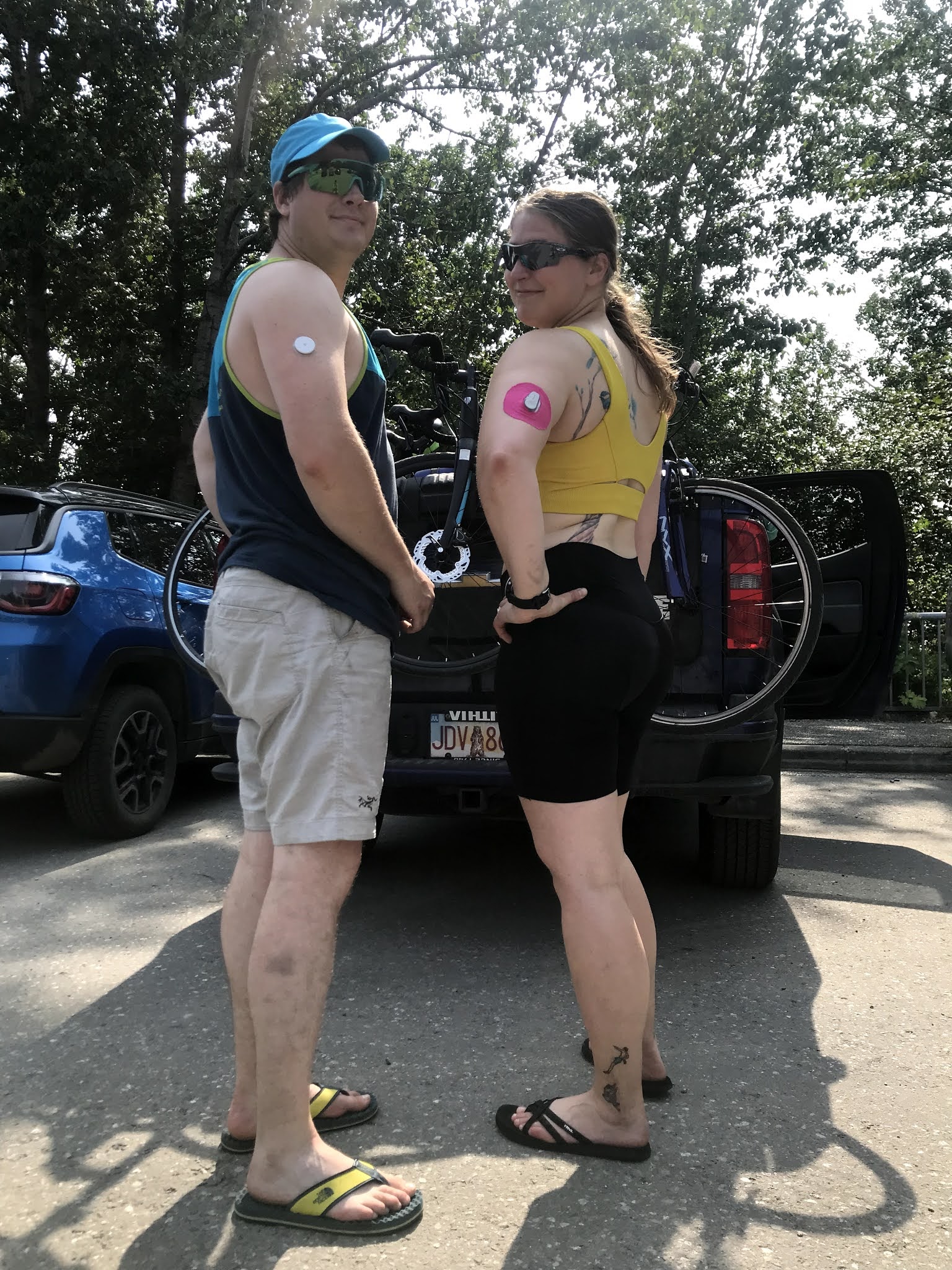
My parents taught us to use education as a tool when people tried to make us feel bad or different. I can't ever remember being ashamed of my diabetes, or feeling like I needed to hide or excuse it. I would (and still do) take injections in public, wear my insulin pump clipped to the outside of my jeans, and display my CGM shamelessly. After all, if I need stuff to stay alive, why on earth should I make excuses for it?
--------------------------------------------------------------------------------
I recognise that my experiences as a diabetic child were unusual as a result of Dad being a doctor. After my sister and I were diagnosed, he began to specialise in diabetes, which opened up a lot of doors and dramatically changed the course of my childhood. So I started asking other Type 1 Diabetics (T1D's) about their experiences growing up. Some people experienced multi-year burn out, were not afforded the accommodations needed to properly manage this disease in school (yes, that's illegal, and no, it doesn't always matter), and struggled with depression and feelings of isolation. Our experiences varied, but common threads remained.
Kenneth was diagnosed soon after his 13th birthday, a few days after the death of his biological father. Obviously, this was overwhelming, but even then he could tell that his mother and step-father were more scared than he was. His mother, like mine, felt incredibly guilty after the diagnosis, feeling that it was somehow her fault. That was difficult to get past because even though he knew her feelings were based on the incorrect idea that she could have prevented his T1D, it still felt like he was the cause of her guilt. Even if we know intellectually that nothing we or anyone around us did caused this disease, it's hard to not feel guilty all the same.
Where my parents were very involved and encouraged self-management, Kenneth's parents fell on the other end of the spectrum, and were mostly hands-off with his diabetes care. Besides some specific occasions like middle of the night tests, he did all of his own injections and testing. In his situation, diagnosed later in childhood, he feels that this hands-off approach was mostly the right one. However, it's still important to remember that the struggle to feel normal can lead to unhealthy behaviour.
--------------------------------------------------------------------------------
And things can get traumatic.
I had hypos because I would refuse to eat after taking my insulin, which ultimately resulted in my parents only giving short-acting insulin after meals.
I flat out refused to use needles, so Mom found a god-awful contraption known as the Medi-Jector which used air to inject. I'm 100% sure it hurt more than a needle, but try telling that to a 6 year old.
I had multiple diabetic seizures caused by hypoglycaemia (extremely low blood sugars) and requiring glucagon injections to treat. In case you didn't know, glucagon can result in voracious vomiting and is pretty much a last resort. (I should note that over the years, I've self-administered glucagon on several occasions. You can take a half-dose of the injectable. It also now comes in a nasal delivery system, which is an all-or-nothing thing, but waaaay easier to administer. For starters, you don't have to do any mixing and messing around with needles in a high-stress situation.)
I refused to log my insulin, carbs, and blood sugar levels (still do, actually).
My mother vividly remembers when my little sister got diagnosed, almost a year to the day after I did. Apparently, when I found out, young diabetic me went, "I'm glad Paige is diabetic. Now I'm not alone."
As we got older, Kenneth and I would sneak food and candy, and then take an extra injection to hide it. We would hide our blood sugars to prevent people from hovering and watching our every move. When I got a pump, life got much easier because I didn't have to try to sneakily take a shot. I went to great lengths to remove anyone else from my diabetes management equation - in my mind, nobody else should be telling me what to do or how to do it.
Yet somehow, I never experienced diabetic burn-out. Going onto an insulin pump when I was 11 provided a degree of freedom that up to that point I'd lacked. I don't remember having crazy issues during puberty or in my teens with my blood sugar levels (but I was definitely an awful teenager to deal with). I navigated my first sexual encounter dodging pump tubing (if you can't laugh about the tubing, you don't deserve me, dammit). I got drunk for the first time knowing absolutely nothing about what alcohol does to your blood sugars, but somehow didn't die or have any hypos. I pulled all-nighters at LAN parties, drinking regular Mountain Dew and Pepsi (I refused to drink diet soda in high school as an act of diabetic rebellion. Yes, I really was that self-aware), I snuck out of the house to do stupid shit (I suspect my parents know, but refuse to ask), and, ultimately, I became an actual adult with a life of my own.
In my household, and thus my universe, diabetes was just one more thing to account for. It was never an excuse to fail, or be cut extra slack, or get special treatment (although in hindsight, I got lots of special accommodations in order to self-manage my diabetes. It just didn't feel like anything special because I didn't get to exploit it).
--------------------------------------------------------------------------------
Here's the thing: I was lucky.
My parents bent over backwards to make sure that we a) didn't die, and b) were able to thrive. Arguments and disagreements about food and treatments were done in such a way that the kids weren't even aware of them - a fact that I'm sure helped us feel like our diabetes wasn't that big a deal. But as I began to talk to my parents about how they dealt with two young, diabetic children, they had some different recollections.
Despite my utter lack of memory involving juice in the house, apparently there was a bit of a show-down between my folks regarding my Dad's morning glass of orange juice. Mom insisted that they needed to lead by example, and if the kids couldn't drink juice just because, neither could they. To this day, juice is a low-treatment in my mind, rather than a tasty beverage for at-will consumption. And apparently, my father no longer even likes orange juice.
Growing up, we weren't allowed to be cranky until we checked our blood sugar. If we were low, we fixed it. But we didn't have the right to be cranky until we know. Recognising the effect diabetes can have on mood and including that the equation when dealing with kids is wild to think about, but in my house, it was normal. Even today, when we're visiting and someone is tired or cranky, the first question is "what's your blood sugar?"
My parents vividly remember the days of having to chase me around the house to give me my insulin injections. I thought it was traumatising for me, but my mother clearly has PTSD from it.
So I asked my them what they wished they knew, and what advice they would offer other parents of diabetic children.
Advice from Parents of Diabetic Children
Diabetes doesn't care if you treat it or believe in it. It doesn't allow concession - you can't not deal with it; you have to find a way.
Without question, having a child get diagnosed is the end of life as you know it. But the new life doesn't have to be any less rich or fulfilling, although it requires a big change in the parent-child relationship. Parenting is about boundaries and expectations, and diabetes adds additional ones. As a doctor, my dad knew about diabetes in theory, but learning to live with it was hard.
Additionally, parents have an obligation to make sure their kid knows that diabetes isn't their fault. Regardless of age, it's not okay to make diabetes the kid's problem, because they need a support system. They have to understand that taking shots hurts, that finger pokes are unpleasant, and that you don't get to do whatever you want. They can't abdicate responsibility of management to the kid; you don't get to say "well, sorry you have this disease. It sucks." and move on. The job of a parent is to help and teach your child to self-manage and be effective.
Empower your diabetic child as much as you can. Give them control, teach them to self-manage, and then (the hard part), let them do so. My parents agree that the hardest part is taking a step back and letting your kid take the wheel.
Encourage autonomy. Adults are responsible for their behaviour, and you want the kids to grow up and choose to make good choices, to be healthy and responsible. But be there through the different stages of their childhood and adolescence - the needs of kids change as they grow.
Bribery is great. Find out what motivates your kids and use it. My dad used to pay me $0.25 per day if I kept my blood sugars below 200 mg/dL (keeping in mind that this was before continuous glucose monitoring was a thing, so it was much easier to "stay below 200" for a day because post-meal spikes didn't get captured).
Having diabetes in the house is a little like having someone with a restrictive diet - the easiest thing to do is remove temptation and have everyone eat the same things. To quote my mom, "why make it harder on people with dietary restrictions?" Control what you can where food is concerned - my parents never forbid anything (except frosting and regular sodas), but by god did we count carbs and try to eat protein with every meal. At Halloween, we would all go trick-or-treating and then sit in the living room and sort our candy. Mom would pull out a "gift box" that was stocked with random, non-food goodies, and we would bargain and horse-trade. At the end of the night, the kids would have a couple pieces of candy left, and Mom would have all the sugar she wanted for a month or two. Mom remembers feeling like they were swimming upstream when trying to establish a non-food-based reward system - you never realise how many traditional rewards are centred around food.
And at the end of the day, recognise that sometimes the goal is to do the minimum needed to stay out of the hospital. And that's okay.
--------------------------------------------------------------------------------
Diabetes management today is wildly different than it was in the late 90s and early-2000s. Where our parents had to rely on finger sticks and log books, today they have CGM's to monitor blood sugar levels, and apps like MySugr to track carbs and dosing. The days of hiding a hypo are gone.
As diabetics who managed to survive childhood, Kenneth and I have some advice to parents and diabetic kids alike:
Kids are tough. There's nothing wrong with checking in to make sure a low or high is being treated. If they're using a CGM and sharing those numbers over the internet, that can be easy, but it's important to understand that too much of a focus on the moment-to-moment aspects of diabetes can cause much more harm than any non-emergency diabetes situation ever could. Kids just want to be "normal", but we don't understand at that age that "normal" isn't really an attainable thing for anyone.
To our parents, for everyone's sanity, don't obsess about high glucoses and what's "best," like perfect carb counting and post-meal monitoring. Instead, emphasise "good enough" habits that allow for a child to responsibly be irresponsible - it's better to lowball the carb count for some unknown food than to eat it and not bolus at all. Almost everything you're told to do by doctors is informed by their clinical understanding of what's best, not a personal understanding of what it feels like to live with diabetes. And almost everything can be done less than perfectly, if that's what it takes to stay engaged with self-care in the long term.
At the end of the day, don't let perfect be the enemy of good. You have to deal with this disease day in and day out, and even the best parent or doctor can't understand exactly what that's like or the number of minute decisions that get made every day. So do what you need to do for your mental health. If that means you let your control lapse for a week or a month because you're burned out, so be it. As long as you do the bare minimum (basal/long-acting insulin and bolusing for food), it's going to be okay.