23 March 2020

Extra Fancy Toys: Tandem t:slim X2 with Control IQ and Dexcom G6

After much excitement (and anticipation), Tandem rolled out their fancy new hybrid closed-loop insulin pump - CGM system, aka Control-IQ. Obviously, I was super excited to try it out and wasted no time in getting my hands on it. 

I figured I'd give it a month or two to put it through its paces before writing a review. It's worth noting that aside from some minor interface changes (which improved the intuitiveness of the system), my original review of the t:slim x2 still applies.

--------------------------------------------------------------------------------

Closed Loop Systems

I'd like to take a moment to point out that Tandem works with Dexcom, who has been working with other insulin pumps (notably Omnipod) to make closed-loop systems available on a multitude of systems. This is a huge step for making diabetes management systems more widely available for people with pumps still under warranty or who don't want to switch systems. The big push for an FDA-approved loop system that allows diabetics to create a closed-loop system on a variety of insulin pumps and CGMs is being spearheaded by Tidepool, who is working with a multitude of manufacturers, including Dexcom, Omnipod, and a couple unnamed pump manufacturers (who I'm sure includes Tandem) to create an iOS-available closed-loop app. A short but worthwhile discussion on this and potential ramifications can be found here.

Also, in case you missed it, the Control IQ software is interoperable, meaning it's compatible with hardware from other manufacturers. Additionally, the Control IQ algorithm was approved by the FDA, rather than a stand-alone device like the Medtronic 670G. 


Control IQ vs. Medtronic 670G

Unsurprisingly, there are already well-written and fairly comprehensive comparisons between the two closed-loop systems on the market. Personally, I like this one (it's a little outdated, but the comparison between Control IQ and the 670G is on point). Another good, detailed comparison between the two systems can be found here.

The Control IQ system works by automatically adjusting your basal rate (aka background insulin) up or down to keep your BGL within a fixed target range. The algorithm uses the rate of rise or fall and amount of active insulin to determine when and how much to adjust the basal rate. Where Control IQ differs from Medtronic's 670G hybrid closed-loop system is that Control IQ delivers automatic-corrections if your BGL is predicted to rise above 180 mg/dL to increase your time in-range (for the record, the next generation Medtronic system will also deliver automatic corrections). This helps reduce highs if you forget to bolus for food. It also has two activity modes that adjust the target BGL range and auto-corrections: sleep mode and exercise mode. I'll get into those in more detail in a bit, cuz I'm super impressed with exercise mode.

The other significant (and I would argue more important) difference between the 670G and Control IQ is that the Dexcom G6 does not require any external calibrations, whereas the Guardian CGM requires calibration twice a day. As always, I'm a huge fan of having as few things to enter as possible to help reduce data entry error.

In case you were wondering, Control IQ is considered more aggressive than the 670G and has a higher time-in-range for users. 

--------------------------------------------------------------------------------

Getting Started

Feel the excitement!

One of the big selling points of Tandem is that software updates can be downloaded directly to the pump, rather than requiring a hardware trade-out. If you recall, I knew Control IQ was in the works when I switched to the t:slim last year, and the easy upgrade was a huge selling point. Tandem cut a deal with the FDA that allows t:slim users to do online training on Control IQ (rather than the traditional in-person training) to unlock a code in order to download the upgrade.

The online training is a couple hours of mostly intuitive stuff, and a detailed breakdown of how the Control IQ algorithm works. Pretty painless overall. Like my transition to the t:slim from my Medtronic pump, the system is intuitive and user-friendly. I continue to be impressed with the interface and durability of the t:slim, as well as the effectiveness of Tandem's customer support team.


By the way, you should definitely WATCH THE TRAINING VIDEOS! My sister, apparently, did not (I guess when you switch to Tandem they don't have a mechanism to force you to do the training videos before using the pump), and as we were discussing how she liked the system, many of the things she brought up were addressed in the videos. So apparently, the videos are good. Watch 'em. Tandem also offers in-person training, which I hear is also good. But, being an anti-social engineer-type, I'm all about not talking to a human if at all possible.

As you may have gathered from the previous paragraph, I recently convinced my sister to switch to the t:slim from her Medtronic pump and closed-loop system. She's been on it for two weeks-ish. When asked, she had the following comments:

- The Dexcom app is amazing (I agree)

- She likes the size of the pump (again, I agree. The t:slim is tiny and amazing)

- She doesn't like that it has to be recharged and has concerns about battery life and not being able to just replace a AA or AAA battery (I had similar concerns when I switched over, but overall have been pretty impressed and not had any issues keeping the pump charged, even in the field or while off the grid)

- The setup was easy and user-friendly

- She dislikes that you can't change the active insulin duration (see my conclusions for a bit of discussion on this)

- The belt clip/pump case is dumb. Yet again, I agree with her. It's worth noting that after my original review, I stopped using the case all together and now just shove the pump into pockets and sports bras. It's small and light enough that this works just fine.

--------------------------------------------------------------------------------

A random aside
As a Tandem user, issues with the Dexcom CGM are now supposed to be handled through Tandem. If you call Dexcom with an issue, they'll run you through their system and then transfer you to Tandem, who will troubleshoot/replace the CGM for you. It's a bit different and I'm not sure why it's being handled that way now, but it seems to be fine. Although if you don't call Tandem directly, you spend a bunch more time working your way through the phone tree. Personally, I think this is stupid.

--------------------------------------------------------------------------------

Activity Mode (and why I love it)

Shocking disclosure: I'm not exactly the target demographic for a closed-loop CGM. My basal rates are good enough that I spend around 80% of time with my BGL in-range, and the spikes I do get are generally post-meal and exercise related. That said, the bane of every active diabetic's life is the struggle to control during- and post-exercise lows. Many of us pre-load carbs so that we go into exercise with an upward trend and use temporary basal rates to reduce during-exercise drops. It's not ideal, and research suggests that one of the reasons Type 1 diabetics struggle to lose weight is that we have to eat carbs (and thus calories) to prevent hypos during exercise, thus offsetting potential gains. Obviously, anything that allows me to use fewer carbs and exercise longer is a win in my book.

So. Activity mode. It comes in two flavours: sleep mode and exercise mode.

Sleep Mode
Sleep mode is intended to reduce nighttime hypos by turning off the auto-corrections and narrowing the target BGL range. You can set it so that sleep mode engages automatically at a certain time for different days of the week, which means there's one less thing to remember to do. I've found that sleep mode helps keep my BGL level while I sleep and I wake up around 110 mg/dL, which is pretty great. It also seems to help keep things more stable while I sleep if I've had a couple drinks (I have a long history of getting low during the night if I've been drinking). In short, sleep mode is 100% worth the cost of admission and it may be worth switching to Control IQ for sleep mode alone.

Exercise Mode
I admit to being skeptical about exercise mode when I went through the Control IQ training. Of all the features, I expected exercise mode to be lacking and didn't have high (read: any) expectations of it being effective. In fact, I had to talk myself into giving it a chance because there was no way in hell it was going to work. Boy, was I (happily) wrong.

Like sleep mode, exercise mode tightens up the target range when activated. That said, I highly recommend leaving it on for a bit after you finish exercising to help mitigate the post-exercise crash. Thus far, I've had great success with eating 15 grams of carbs before starting a run and leaving exercise mode on for 30 minutes after I finish. Once again, between the target range while in exercise mode and the auto-adjustments of the Control IQ algorithm, I highly recommend the pump for activity mode alone. It's worth keeping in mind that going into exercise with minimal insulin on board (IOB) helps keep your BGL level.

Exercise mode has noticeably reduced my hypos during exercise (circled in yellow). Yes, I'm totally showing off. But also, I really do love it.

--------------------------------------------------------------------------------

Conclusions

Things I love:

- Exercise mode is the bomb. F'reals. I love it and 100% recommend utilising it. As an active diabetic, I've been engaging it during cardio, like running or hiking, and strenuous activities (hauling pallets of sand comes to mind), but not while climbing, which doesn't seem to affect my BGL much.

- Sleep mode is also the bomb. My husband reports feeling less anxious about nighttime hypos since I switched over, too.

- The CGM reading is automatically filled in when you open the bolus screen (using Basel IQ you had to enter it manually).

- I have had a noticeable reduction in swings (both up and down) using Control IQ.

- I have an increased time in range and am loving it. That said, it's worth noting that it seems to take a few days (or more) for the algorithm to fine-tune itself for each personal profile (aka basal rates and ratios), so if you switch profiles, you'll see some variation in your BGL's before Control IQ starts being super effective. The only reason I noticed this is because I work night shift in the field and switched onto my "night shift" profile (which is literally my normal profile offset 12 hours).

- The size. I continue to love how small the t:slim x2 is (if you recall, it was one of the reasons I switched systems). I don't use a case and just shove it in pants pockets or a sports bra, which works shockingly well.


Things I don't love:

- Control IQ doesn't take into account the carbs on board in the bolus calcs. What this means in practice is if your BGL is below target and you treat with carbs, the pump recommends a reduced bolus. If you eat something else after treating the low, Control IQ will continue to recommend a reduced bolus, even though that is functionally double-correcting. The workaround is, obviously, to override the recommended bolus if you eat after treating a hypo. It would be nice if the Control IQ algorithm actually accounted for carbs on board as well as IOB (I should note that the Loop systems, aka hacks, do account for carbs on board).

- I've been having ongoing issues with losing connectivity with my Dexcom. It's weird (and annoying), since this issue only started when I started using Control IQ (wasn't an issue with Basal IQ). A quick internet search shows that I'm not the only person having connectivity issues with the Dex using Control IQ. In addition, I keep having issues with my CGM requiring manual calibrations upon startup, even though I have the code. I've talked with both Dexcom and Tandem about this, and once we get past the "it only asks for calibrations if it needs them" speech and I get them to understand that the CGM is requiring calibrations every 24 hours (barf), they've been... well, sorta helpful. It's annoying as shit and makes me kinda cranky with Dex. If we're being honest, the batch of sensors I've been having issues with may (read: definitely) have had some exposure to extreme cold that I'm starting to suspect messed with both the adhesive and the internal workings.

- You can't change the active insulin duration. When you're using Control IQ, it's set to 5 hours. For many of us, this is too long. I had to counter-act this by changing my food to insulin ratio and my correction ratio, resulting in a net increase in insulin usage. After talking with my sister, she had the same comment and also adjusted her ratios to compensate.

- Occasionally the screen turns off while you're mid-bolus. This doesn't interrupt the bolus, but you do have to unlock the screen again. After talking to a couple other t:slim users, this seems to be something we've all experienced. It's not particularly disruptive, but it is kinda annoying and enough to warrant a minor bitch-fest during the discussion.

--------------------------------------------------------------------------------

Final Thoughts

I continue to love Tandem and their customer support team, and Control IQ is just another reason to be happy. I've found it works well (and as advertised) and is user-friendly with an improved interface. While there are a couple features that I wish were different (notably the insulin duration), there are work-arounds (changing food and correction ratios), but they result in an overall increased insulin usage.

The one feature of Control IQ that I was sure would be garbage turns out to be my absolute favourite. Activity mode is a powerful tool that should be utilised by all users. Sleep mode is an excellent way to help prevent nighttime hypos, and exercise mode actually works exercise mode has a place (see update below for revised conclusions). Honestly, it's almost worth switching to Control IQ for no other reason than to utilise activity mode.

Unfortunately, the Dexcom is the weak link in the system. I'm not sure where the issue originates, but I suspect it's something with the pump, since connectivity issues don't seem to extend to the phone app. I've been having some non-pump related issues with the Dex as well, which hopefully will get resolved. That said, the issues with the Dex are not significant enough to keep me from recommending Control IQ.

tl;dr
Control IQ is awesome and you should use it.

--------------------------------------------------------------------------------

Update (5/30/20)

I've revised my opinions on the effectiveness of Activity Mode as far as endurance activities (long, hard hikes and runs). Two months and 150 miles in, and I am less enamoured with it. It turns out, my 30-year-old body doesn't like to process sugars or carbs while exercising. Also, I get ultra-sensitive to insulin while running / doing aerobic exercise. Looking back, I've addressed this by carbo-loading and setting temp basel rates, going into long runs with a high blood sugar and no insulin corrections. Unfortunately, the Control IQ algorithm doesn't allow you to do this effectively, what with the auto-corrections to keep you in the target range and the inability to set temporary basal rates.

As I've upped my milage to 20-ish miles a week, I found myself constantly fighting hypos. I started messing around with my diet in an attempt to stave off the inevitable crash during long runs, joined a couple Facebook and reddit type 1 diabetic running groups, and trying different supplements and gels on the recommendations of other T1D runners. After much struggling and many hypos, I also stopped trying to make Control IQ work for runs farther than 3 miles and started turning it off so I could set a temporary basal rate.

So basically, Activity Mode works well until I'm doing prolonged aerobic activities, at which point I have better luck going manual (you do not get the auto-suspend when your CGM is trending low this way, fyi).

Regarding the Dexcom

I don't care what the official line is from Dexcom, something in their adhesive has changed that I (and many other T1D's on the internet) am super allergic to it. I'm officially doing the "sandwich" method, consisting of Flonase, tegaderm, insert sensor on top of tegaderm, then put a grifgrip patch on top. It's a lot of tape, but at least I don't get nasty, puss-y bubbles and rashes this way. Also, inserting the cgm through a barrier is not recommended (by Dex).

The customer service folks I've talked to at Dex (who are awesome, btw) have mentioned they've been receiving a really high volume of calls regarding reactions to the adhesive. Despite the fact that they insist nothing in their adhesive or manufacturing has changed, the evidence does not support that claim. It only takes a quick perusal of T1D forums to discover a surge in complaints about adhesive reactions starting around January. 

23 August 2019

Let's talk kids (or not)

So we (me and Ev) have reached at a point in our lives where people want to know what the plan is.

And by "plan", I mean if we're going to have babies.

And by "if", I mean when.

So you can imagine the reaction we get when we go "we're not going to have kids."
(Note: We’re at that age where it’s not an unreasonable question, so ask away. But only once. And then listen to the answer and let it go)

For some reason, I usually feel obligated to justify myself:

I've never wanted them.
I don't particularly like them.
I'm a medical disaster and don't want to pass that on.
I don't want them.

I get that we're at that age where people get married, buy a house, and have kids. Hell, I've checked two of the three boxes. And it's pretty great. But I have zero desire to have kids. And that's my (and Ev's) choice. We're on the same page in this regard. We've talked about it. We don't want them. We're not going to have them. The end.

Or at least it should be.

It's a bit horrifying how often we hear some variation of "oh, you'll change your mind." Or "don't you feel obligated to have kids since you're both smart and stable?" Or my personal favorite, "you'll never be truly fulfilled if you don't have kids." 

I'm not sure why, but apparently it's okay to judge people on their conscious decision to not reproduce. 

Now please don't misunderstand me. I have nothing against people having kids. I know a bunch of people who want them and have had planned pregnancies, children, and all the struggles associated with trying to get pregnant. There is absolutely nothing wrong with wanting and having kids. Arguably, the world needs more parents who are in a position to plan for and support the crap out of their children. But that doesn't mean I need to be one of those people. 

Hopefully, we'll age out of this. Eventually. In, like, 10 years. 

Fun fact:
Millennials (yes, I'm one of those) are making very deliberate choices when it comes to having kids. Statistically, we're waiting longer to marry, buy houses (if we do at all), and have kids. Reproduction is both a personal and environmental choice these days. 

I know people who have tried for years to have kids and haven't been able to conceive and have ended up adopting - which is amazing on many fronts and they're great parents. I know people who have had kids basically as soon as they've started trying. I know people who have gone through fertility treatments up to and including in-vitro. We also have friends who are taking a step back and going "I want kids. Is this the person I want them with?"

And I know people who, like me, have chosen not to reproduce, who have made a deliberate decision to not have kids. And we all have experienced that annoying, patronising person who insists that we'll change our minds, implying that we aren't capable of knowing what we want for ourselves, of planing ahead, of making financial and personal decisions that will influence the rest of our lives.

It is incredibly condescending and, let's be honest, rude, to insert yourself into someone else's reproductive choices. It is not your business. It is never your responsibility. The decision to have or not have kids is monumental and deeply personal. Yet for some reason, people feel like it's okay to comment on it, even if they know nothing about your circumstances - imagine how awful it is if you've been trying to get pregnant for years, gone through fertility treatments, maybe in-vitro, and not been able to conceive. Maybe you or your partner is unable to reproduce. Maybe only one of you wanted kids and it ended the relationship.

My point is, don't comment on anyone's decision to have kids or not. 

You don't know what they've been through.

You don't know the choices they've made.

So basically, shut the hell up before you decide to tell someone they should have kids (While you're at it, keep your opinions to yourself when talking to pregnant woman, people with babies... actually, maybe just don't tell anyone how to live).

Nobody has an obligation or duty to have kids (well, short of the royal family, but that's just some weird, out-dated shit).

And also, it's really bloody rude.

19 March 2019

Night life

There has been a lot of field work in my life so far this year. 

And by "a lot," I mean "5.5 weeks and still counting."

It's a good thing I really like playing with dirt, cuz night shift (protip: always work nights, people leave you alone) is slowly losing our collective mind. Part of me wishes there was a camera in the drill sled that we could reference to track the slow, inevitable decline of our sanity as the weeks progress. 
Nope. No sanity here. Sane people don't get this exited about dirt 4 weeks into a job.
On the plus side, the arctic in winter has potential to be absolutely stunning, even if it does get super nasty and horrible outside. I'm grateful for the drill sled every time I go outside to pee.


It really is a super-slick design that makes for nice, warm working conditions in the middle of winter. Add in the fancy new drill, and we've drilled a LOT of holes with Onyx Drilling (my night shift driller and I broke 500 hours together this hitch last night). 

Anyways.

I'm alive. I think my driller and I have crossed any lines that may have lingered from the previous two years of working together. We've listened to possibly all the music. We have been working to embrace our inner otterness. And we've been listening to a verse of Tao every shift in an attempt to better ourselves, center our chi, and not completely lose our minds. It's working surprisingly well. And by that, I mean nobody has completely lost their shit or had a breakdown. Calling it a win. 

So yeah. One of these days I'll get around to that blog post about our magical vacation in Cayman Brac. But today is not that day.

06 February 2019

Fancy New Toys: Tandem t:slim X2 & Dexcom G6

A couple months ago I decided it was time for a change.

It had been a long time coming - after years of no significant diabetes incidents, I had three in a two month period. While the Freestyle Libre sensor has been amazing since I started using it in 2015 and I cannot recommend it enough, I (*cough*Everet*cough*) decided it was time for a pump and sensor that talk to each other. 

You may recall my adventures with the Medtronic 640G (aka the 630G/670G in the USA). It was one of those "well, it's a nice idea but I kinda hate it" experiences. I ended up switching back to the older version (Paradigm Revel), but then Medtronic decided to stop manufacturing the smaller (180mL) version. So when I had to warranty my pump due to a crack in the reservoir, I got stuck with a 300mL pump, which is significantly bigger. Contrary to popular belief, size does matter, and I couldn't help but feel that Medtronic was focusing on their software and ignoring the actual hardware and what the end users are looking for. The pump is big, the sensor (the current Medtronic sensor is the Guardian) is large... and while the technology is great, it's just too big for my liking.

6 months later and I'd reached a point where the size was just too much.

Enter research mode:
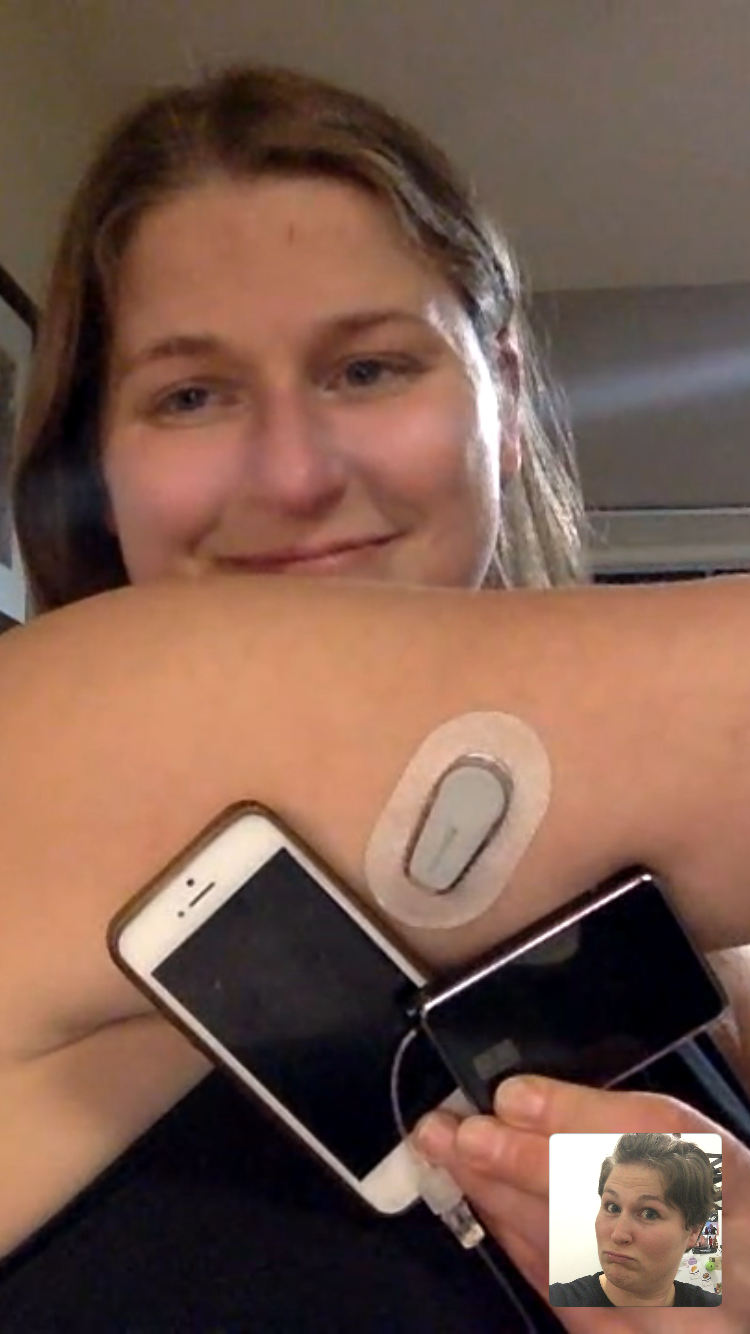
I started with a Google search of "smallest insulin pump" and ended up winding my way to the Tandem t:slim X2, which communicates with the Dexcom G6 CGM. For reference, here are photos of the Medtronic 670G (top left), Tandem t:slim and Medtronic 530G (top right), and the full t:slim and Dexcom G6 setup, with an iPhone SE for scale.


-------------------------------------------------------------------

Obviously, I'd hate to do something the easy way, so I started the pump-swap process at the end of December. Because normal people take holidays, this meant the actual paperwork didn't get started until early January, at which point we were fighting the clock: I'm heading out for field work at the start of February. 

The folks at Tandem have been great to work with from day 1. They bought out my Medtronic warranty ($999), made sure that the insertion sets were going to be comparable to what I'd been using, and got things on their way in under a week after making contact. Additionally, their reps are full of useful tips (your pump stops receiving your CGM sometimes? Wear it glass-side-out. BOOM! Problem fixed).

------------------------------------------------------------------

Full disclosure: I did not do a formal orientation on the pump and CGM. Things went kinda like this:

1. Pump shows up at the door. Make really excited noises and explode the box all over the kitchen.
2. Wait 2 days for current infusion set to end. Program all the basal settings into the t:slim.
3. Carefully read the instructions on changing your set. Twice. Because WTF? This is different.
4. Change set and start using fancy new pump.
5. CGM's show up at the door.
6. Put one on, make it talk to the pump, carry on as usual.

My point being, if you're not comfortable playing cowboy or are new to the pump-CGM systems, you should really have your doctor/company reps involved. They'll walk you through the system, show you the features, how to use them, change your infusion sets, etc. In short, they're resources that are available and should definitely be utilised.

------------------------------------------------------------------

Anyways. On to the pump review.

The Features
The big selling point for the t:slim x2 is the ability to anticipate and try to address low BGL before they happen. Medtronic's 670G/Guardian system is the only other pump-CGM system on the market that offers the same features. A neat little comparison between the two can be found here. Note that the major difference as an end user is that the Guardian requires daily manual calibrations, while the G6 does not (although there's an option to enter a calibration if you want to).

The Basal-IQ feature is Tandem's response to Medtronic's predictive suspend. Basal-IQ turns the pump off when it's predictive algorithm predicts your BGL will dip below 80 mg/dL in 30 minutes. The pump also turns off when your BGL dips below 70 mg/dL. It turns the pump back on when the CGM reading increases. If the CGM increases then starts to trend down again, the pump turns itself back off.

Also, you can have multiple basal rate programs that you can switch between at-will. In the Amy-verse, this means you can have a "working" program where you fiddle with basal rates to fine-tune things. Yes, I make awesome choices. No, you probably shouldn't mimic me.

The Set Change
The reservoir filling is a bit awkward. Where Medronic has a needle integrated into the reservoir when you take it out of the packaging, Tandem's system requires using a syringe to fill the reservoir. Hello, having a sharps container back in my life. The overall set change process is a bit more complicated and time consuming, but the menus are simple and intuitive.

The supplies required for a set change of the Tandem t:slim 


My biggest gripe with the t:slim is the complexity of the reservoir/set-change process. There's a lot of room for user-error to introduce air bubbles into the system. The biggest pain in the ass is that the t:slim requires you to pull all the air out of the reservoir before putting the insulin in. The reservoir - tubing connection kinda gets in the way of this.


Also, can we talk for a minute about the weird-ass shape of the reservoir? I get the whole "need-a-patent" thing, but the little connection tubing is a wee bit annoying to work around when filling the reservoir. It looks like a tiny space gun.


Now a word of warning (I'm going to mention this a couple times because it's a big fucking deal):
The reservoir can pop out of the pump when taking it out of the case. The pump case is designed so you can change your infusion set without taking the pump out, but what that actually translates to is that you can accidentally remove the reservoir if you're taking the pump out in and out of the case regularly. Personally, I've been skipping the case during the day and just putting it on so I can clip to my shorts to sleep. Guess how I know about this issue?

Yeah. It keeps happening when I take the case off.

The Sensor
Dexcom managed got FDA-approved for a 10 day wear with no finger stick calibrations on the sensor, which makes the product competitive with the Libre, albeit a bit bigger. 

Left - Freestyle Libre. Right - Dexcom G6


OK, I lied. The adhesive on the G6 is massive.... but the actual sensor isn't that much bigger. 

For comparison, here's the Medtronic Guardian CGM. Note that everyone I know who uses it ends up putting additional adhesive on over the top of it, so the actual footprint of the sensor is bigger than what Paige is modelling. 


The CGM-pump setup is super easy and painless. You get a little countdown timer on the pump during the calibration period, then you can view your current BGL and history from the lock screen. You can easily switch the time window between 3, 6, 12, and 24 hours, which is super slick.


I did some mucking around with the CGM alarms until I found something that wasn't going to make me homicidal. In the never-ending battle against alarm fatigue, sometimes it's best to keep it simple. You can turn off the alert when the Basal-IQ kicks on and off to auto-suspend the pump, but you'll always get low/high BGL alerts. Which are really the ones you want.

Update: It's worth noting that there is a hack for the G6 that will let you reset the sensor and get another 10 days out of it. The adhesive doesn't like to last that long without some help, and it's definitely not an approved thing, but it's always worth knowing you can get a little extra out of the sensor if you have to. 

Also, there is a known issue with getting a sensor restart error if you change the sensor too fast. According to the tech support folks, you need to wait 5-10 minutes between ending and starting a new sensor to prevent the transmitter/whatever from thinking you're just restarting with the same code. They do send you a new sensor if this happens, but it's a massive and really stupid pain in the butt.

Taking Insulin
The first couple days on the t:slim I continued my old ways and entered in the units I wanted to take manually, rather than using the carb and correction calculations and letting the pump do the math. 

What I found, however, was that the Basal-IQ would kick on and I wound up yo-yo'ing. Apparently my general rounding wasn't something the system was down with.

Eventually, I decided to use the pump the way it was intended (novel thought, I know). Oddly enough, it seemed to help level out the swings. Besides, taking a bolus is so quick and easy, even when you're using the carb ratios, that it doesn't influence the amount of time you're looking at the pump. 

That said, I've had to adjust the amount of carbs that I use to treat low blood sugar levels. The Basal-IQ suspending the pump means that I ultimately need fewer carbs to turn things around. Cue breaking a 24 year old habit. This is gonna take some time.

-------------------------------------------------------------------

Pros:
- There is a "quick bolus" feature (similar to the easy bolus on Medtronic pumps) that's actually easy to use. For someone who spends a lot of time with their pump in a bra or some other place where you really can't pull it out, this is critical. Also, the pump vibrates when you activate the quick bolus, when it accepts the amount, and when it accepts the bolus. It's a nice tactile cue that things have gone according to plan.

Oddly enough, it's almost just as easy to just pull out the pump to deliver insulin if it's in a pocket, rather than using the quick bolus. That's novel for me, since I've been pocket-pumping for the last 17 years. The bolus feature on the t:slim is just so slick and easy with the touch screen.

- The t:slim is updated via software downloads from your computer. This means that when the FDA finally approves a closed-loop system (or even letting you program boluses from your phone), I'm only a download away from never having to rummage around in my boobs or up my skirt again.

- The pump screen is still readable and easy to use (I'm always wary of touch screens) after being coated in boob sweat during a run. I can't even count the number of pumps I've had to replace due to boob sweat over the years, so that bodes well. Also, no issues with glare or polarised lenses.

- You can get pump cases in fantastic colors. Like blue and pink. It's amazing.

- The pump is super slim without a case and fits easily in a sports bra. It even lays flat! (Disclaimer: you're gonna want to buy a bra with a phone pocket so the pump can stay facing out)


Cons
- The screen is dark if the pump isn't actively in use, so you can't use it as a watch. I'm going to miss my 'boob clock'.

- The Dexcom G6 adhesive is huge. I get that it's to keep the thing on, but holy crap. Gargantuan. There is no subtlety wherever you put the CGM. On the other hand, no one will ask me if it's a nicotine patch... so one up on the Libre?

- The G6 transmitter was designed to transmit to something with a fairly powerful receiver (aka a phone). Unfortunately, the t:slim receiver isn't nearly as powerful as the phone, so there's a pretty significant line-of-sight effect between the CGM and pump. Basically, the pump needs to be on the same side as the sensor with have the glass facing out to consistently pick up the CGM. Given Dexcom's history of being responsive and releasing updates to their tech fairly frequently, I have a hunch this will be addressed in the next version of the CGM. (Update: after much field work, I've decided that it's the pump case that's the issue. As long as the pump is screen-out, it talks to the CGM)

- You have to disconnect to take the pump clip/case on and off. Kinda annoying (but not the end of the world). However, it's easy to accidentally remove the reservoir taking the case off. You can just push the reservoir it back in and all is good (no priming required), but if you're not paying attention and looking for it, it would be scarily easy to not realize your reservoir wasn't actually installed.

- The tubing comes in 23" (aka really short so don't drop the pump) or 42" (aka long enough to take up fancy knot tying). A nice 32" tubing would be perfect.

- The connection between the reservoir and tubing is definitely the weak point in the system. If the pump is stuffed in a bra (or upside down in a pocket,or whatever) for long periods, the tubing kinks a little and you get No Delivery alarms. Straightening out the connection so the tubing runs straight in/out of it fixes the problem, but what it means in practice is that you need a bra with a pocket or pouch so the pump orientation can be fixed to avoid kinking the connection.


Wait and See:
- I'm not sure how I feel about this super basic pump clip. It's all but impossible to clip onto a real bra, but does seem to hold pretty well to sports bras and leggings. On the other hand, you have to disconnect your pump to pull the tubing through it to take it off. I've found myself wearing the pump without the clip around town because it's so slim it fits in my girl pants pockets so well you can't even see it.

- The pump is rechargeable and theoretically can charge to a safe level while you're in the shower. After running it down to 10% (FYI, it starts yelling at you below 25%), it took around 30 minutes to charge to 50%, and another 30 or so to get all the way to 100%. Topping up the charge every couple days or when you disconnect to shower is definitely a good way to keep from needing an emergency charge. I made it about 5 days on a CGM before I had to charge it.

Next question: will I be able to charge it using power packs/portable batteries while hiking or camping. (Update: yup, you can charge the pump off a power pack. Yay!)


-------------------------------------------------------------------

The Verdict
Thus far, I've been really impressed with the ease of the transition to the t:slim and G6 system. The pump itself is intuitive, small, and the customer support has been fantastic. The G6 has insanely large adhesive, but the integration with the pump is good and the adhesive stays on for the full 10 days. My biggest gripe is that the pump and sensor need to be on the same side of your body to ensure transmission. I went into this fully prepared to hate the reservoir-tubing connection being a couple inches off the end of the pump. Much to my surprise, it's been pretty much a non-issue as far as getting in the way and catching on things. Although I do live in fear that it'll somehow unscrew itself. (Update: the only issue I've found with the connection is the aforementioned No Delivery due to kinking at the connector. Easily solved with pump placement, but an inconvenience if you don't want your pump in a pants pocket for reasons such as, say, not wanting to damage it when you're swinging around 80 lbs augers and bracing them on your leg.)

I definitely have to adapt my management habits to accommodate the Basal-IQ and all that fun stuff. For people transitioning from the Medtronic system, this will likely be a non-issue. For those of us who have been stubbornly refusing to relinquish any kind of control, change is hard. 

19 October 2018

Nobody Likes Getting Catcalled

I started writing this last year (time stamp is 28 June 2017), then decided not to post it. I'm not sure why, exactly. Maybe because I hate advertising when I'm uncomfortable (I tend to view my discomfort as weakness, and insecurities as cop-outs), but upon further reflection, that's not being fair to myself. I'm entitled to my feelings, my experiences, and my viewpoints. So on that note, here's my unfortunately-still-relevant take on sexual harassment, first-hand.
----------------------------------------------------------------------------


Last summer (early June 2017) I got catcalled when I was walking from my office to meet Ev for lunch. The guy rolled up next to me in his big red truck with the window rolled down, leaned over and informed me that I have a "nice ass".

Objectively, there was nothing overtly threatening about the encounter. He was in a car and I was on the sidewalk. He drove away when I looked at him and spread my hands in the universal "what the hell" gesture. There was minimal opportunity for physical escalation. He didn't proposition me.

But I felt undeniably violated.

I've been trying to put my finger on what it was about this brief encounter than left me feeling defiled. The analytical part of me wants to take context into account, give him the benefit of the doubt that his intent wasn't to creep me out. But the rest of me can't. There is no way that interaction had someplace to go; there was no way to continue the conversation, no chance in hell I was going to get into the truck, and no real way for me to extract myself. The entire interaction was on his terms and I had no say in the matter. 

But seriously, in what universe is that supposed to be considered a compliment? It what universe does that do anything but make me feel threatened?
----------------------------------------------------------------------------

A few weeks ago, my coworker and I walked from our office to a nearby coffee shop. It was a nice day, so we went the long way around (turned the 5 minute walk into a 10 minute walk). And as we turned down the street, a car with two middle-age guys slowly pulled out of an empty parking lot in front of us, proceeded to roll down both windows and drove very, very slowly down the middle of the road in front of us. We started walking slower, and they stopped the car in the street, waited until we got close, then started rolling forward again.

So we ducked into a random framing store that we'd never set foot in before. The owner stuck her head out, and we went "sorry, we're hiding from these creeps who are following us. Can we stay here for a few minutes?"


The fucked up thing is that I bet every woman I know has a similar story. Or, let's be honest, stories. Because that is the world we live in. 
----------------------------------------------------------------------------

The concern I've heard voiced again and again by men (sorry, boys, I'm not trying to pick on you, it's just that this particular issue splits primarily along gender lines) is "How do you differentiate flirting from harassment?"

Good question. 

Some things may be considered totally fine if you're into each other, but creepy as hell if it's unwanted. So, and listen carefully here: both parties have a responsibility to communicate when they aren't interested. Guy hits on us at a bar and we want none of it? Great. Nonverbal communication is nice, albeit not always clear enough (some people are just oblivious). Shake your head, walk away, ignore them. Use your words and tell him you're not interested. Fuck it, lie and say you have a boyfriend. Or a girlfriend. Also, never, ever touch the other person if they wave off your advances (I'll get to that in a minute).

The flaw in this logic is that it only works if the offending person accepts and respects the other's disinterest. And that seems to be where issues arise. Some people have a hard time reading (or respecting) non-verbal cues. That said, if someone tells you they're not interested but you persist in your advances, you've crossed the line between flirting and harassment. The romcom's are a lie; persistence is not an ok way to get the girl.

Note that I'm not saying "sexual harassment." Sexual harassment has a pretty specific definition that originated in the context of workplace discrimination. Harassment, on the other hand, describes behavior that "annoys, threatens, alarms, or puts a person in fear for their safety." Basically, if the attention is unwanted, unwelcome, uninvited, AND threatening, offensive or demeaning, it qualifies as harassment. Notice the "and" in there. Someone talking your ear off and not taking your subtle hints to go away isn't harassing you unless they're also propositioning you, intimidating you, touching you or orienting themselves in a way to prevent you from leaving. It's that touching thing I mentioned. And following someone around pestering them for a date, showing up at their work, home, or whatever is harassment and stalking, which is a very unsexy combination.

The point I'm trying to make is that the legal definition of harassment is pretty clear. Flirting in the normal, healthy sense is absolutely not harassment. And if you want to put a stop to (most) unwanted flirting, say so. Remember, subtlety is not key here. Again, romcom's are a lie and you should not under any circumstance show up at someone's house with a boombox to get them to go on a date with you. 

If you're feeling feisty, you can always take a page out of my book and keep some fairly brutal comebacks in your back pocket. 
----------------------------------------------------------------------------

I have a radical suggestion when it comes to harassment: don't make assumptions.

Don't assume that the other party means anything other than what they say, especially if they're trying to extract themselves from the situation. Don't assume they're comfortable enough to tell you to fuck off.

Don't assume you have a right to someone's time or attention.

Don't assume that what someone is wearing (short skirt, tight shirt, whatever) gives you permission to proposition them or flirt. 

Don't assume that you have a right to touch someone. Hand, arm, back, whatever. Remember that legal definition of harassment? Touching can push you over the line between annoying and threatening. So no touching unless the flirting is being reciprocated. 

And for the party on the receiving end of the unwanted attention?

Don't assume the annoying flirty guy is picking up on your signals to back the fuck off. Get up and walk away. Go to the bathroom. Make the random person on your other side your new best friend. Use you words. Say "not interested." You don't need to be polite, and frankly, being labelled a bitch isn't the end of the world. Take it from me, it's kind of fun.

Don't assume that the boisterous dude hitting on you and touching your arm is trying to be intimidating. He's probably not, but that doesn't mean you have to put up with it. Move his hand. Step back. Tell him to not touch you. If he's not a piece of shit, he'll respect your space once he knows you don't want him in it. 

Don't assume that ignoring someone will make them go away. Don't assume that you're safe. Don't assume that everyone who gives you unwanted attention is an asshole. Don't assume that they're not. 

While I'm at it, don't follow people down the street or catcall them. It's not a compliment. It's not flattering. It's not welcome. Ever.
----------------------------------------------------------------------------

As a woman, being upfront and blunt about your interest is hard. We often have to weigh the potential threat level before we even open our mouths. Where are the exits? Is there someone around who might help me if things don't go well? Can I outrun him? Can I overpower him somehow? Is rejection going to make him angry and dangerous? Every woman does some split-second assessment every time she interacts with a guy she doesn't know. More often than not, it seems like the safe bet is to use body language, try to extract yourself without offending him, or just ignore him. Which is bullshit, because it puts the onus on the woman to not get harassed.

It's a fine line to walk. Hell, it's an impossible line to walk.

Most guys mean well. If they're being threatening, it's probably not intentional. They may be oblivious, but they're probably not dangerous. 

But the guys who just don't care? They skew everything. And addressing the problem will require a shift across the board. We need to change the way we talk about harassment and gender equality, what we teach our kids about how to treat each other, how we confront people who are perpetuating harassment. The victim blaming has to stop. Demonising every man who makes a stupid comment has to stop. We must be willing to communicate, to listen, and to turn uncomfortable situations into teachable moments. 

We have to recognise that this will take time, and it will likely fall on my generation to implement lasting change; sometimes people just can't seem to move past the way things used to be.

I've said this before, but it feels like it bears repeating:

Now is the time to speak out when you see discrimination, to stand up against racism, sexism, xenophobia, homophobia, and hate. Now is the time to be an inspiration.

Let’s be the change we want to see.

13 October 2018

It's been a busy summer

It has been pointed out to me that I am really overdue for a blog post. 

When I tried to claim that my life isn't that exciting and nothing new has happened, it was pointed out to me that since my last post I've gotten married, am in the process of buying a house, and done lots of outdoors adventuring.

Basically, I'm full of shit.

So yeah, welcome to the fall 2018 edition of "Amy's life in short sentences and lots of pictures". 
--------------------------------------------------------------------------------

I feel like I've spent more time in a dress this summer than I have, like, ever. My sister got married mid-June in a beautiful back yard wedding (which for obvious reasons stressed my mom out, since it was her yard and the gardens had to be perfect. Which they were.). They had a very traditional ceremony and reception, which suited them perfectly and was a lot of fun. The extended family came up for the wedding and it was lots of fun having everyone together.

Plus, we got a couple pics of the Steinettes with everyone's eyes open (a minor miracle).


It also took all the pressure of me and Ev, since we kinda didn't invite anyone to our wedding.
--------------------------------------------------------------------------------

On September 4, we forced our immediate families and a couple very close friends to hike up to the top of Crow Pass with their camping gear. People didn't complain too badly, probably because we also brought up cupcakes and champagne.


Actually, we forgot the cupcakes in Anchorage and made Daniel swing by the house to get them on his way up. Colin and I hiked down to the parking lot to meet him and carry them up, which resulted in a super close encounter with a mountain goat who did not give a shit. It was awesome.

So anyway, everyone managed to hike the 3 miles uphill, pitch a tent, and have a lovely evening in the mountains.
The tent farm, aka what happens when you attend my wedding
There was lots of goofing around, camp food, and Adam's impressive little wood-burning stove thingy that you could make smores on. Which was super awesome, except Rachael couldn't seem to get her marshmallow cooked evenly and was very sad.


On September 5, Ev and I got all dressed up, borderline hypothermic, and married. Adam performed the ceremony, which, this being Adam, could have been anything from super serious to a rambling dick joke. He struck a nice middle ground and it was pretty much perfect. Rachael did a very impressive job with my hair in the tent, and nobody died of cold. 


On Monday, everyone reconvened for a quasi-reception dinner and Paige made us cake. And it was awesome.


--------------------------------------------------------------------------------

But wait, there's more! 

Because apparently I am incapable of having just one big event, we ended up with several small-ish things. The official wedding reception was in Dillingham. This served two purposes: first, it gave my parents an excuse to go to Dillingham, since they'd never been and that really needed to get fixed. Second, Dillingham is awesome and it was a good excuse for people to come visit.

And visit they did. Lorraine came all the way from the Netherlands to hang out with us for a week and come to our reception. All she asked was to see a moose or two, so naturally, Alaska obliged. 


So people converged on Dillingham and it was magical. Lorraine and I fondled some marine silt, and Ev and I napped on the couch. Also, we had a really really good dinner with people we care about. Apparently wedding receptions are mostly an excuse for your friends to tell embarrassing stories about you.


--------------------------------------------------------------------------------

And that just about catches us up on the last, oh god, 3 months. 

Well, mostly catches us up. But I gotta save something for later, right?


12 June 2018

I'm really good at failure

I've read a couple books recently that talk a lot about how we define failure and success, what goes in to making decisions, and the seemingly endless pursuit of happiness and perfection. And, I'm going to be honest, I really liked the conclusions: success isn't all it's cracked up to be.

There's a school of thought (which, granted, sounds a bit trite) that failure is more valuable than success. At the most basic level, you'll never fail if you don't push your limits. In that sense, failure is simply part of the learning process. Dig a bit deeper, and you'll find that failures are often tipping points - the impetus to train harder, change jobs, make different choices. Arguably, our failures define us more than our successes. And what we do with those failures can make us stronger and smarter, or tear us apart. 

-----------------------------------------------------------------------------
These days, it seems like everyone loves to rip on Millennials. We're lazy, entitled, ruining the housing economy by renting instead of buying, obsessed with instant gratification and image, and constantly comparing ourselves to everyone else on social media. We present bite-sized pieces of ourselves to the world, trying to make our lives look perfect and fulfilling. We broadcast our lives to the world, and try to gloss over the failures that led us to where we ended up. The struggles and failures aren't mentioned until they've been overcome. We're all about lessons learned and being an inspiration. 

Let's get one thing straight: Millennials are not lazy or entitled, we just refuse to work for free and strive to have something resembling a work-life balance (something I'm admittedly terrible at). We've born the brunt of the 2008 financial crash and broader trends in the workforce that result in a generation projected to make less than our parents. We buy fewer homes and do so later in life due in part to the migration to cities and crippling student debt. Although we actually have less debt than previous generations. Go figure. I could go off on this extensively, but, let's be honest, other people have and much more eloquently than I can. So I won't. 
-----------------------------------------------------------------------------
So back to failing.

I'm really good at failing. 

Seriously. I fail a lot. I joke that I try to be wrong at least once a day, and that I actually have no idea what I'm talking about but get away with it by saying it with confidence. The first part isn't intentional but happens anyway, but the second part seems to happen a lot. 

I pride myself of working hard and being willing to put in extra time to do it right. Of course, that doesn't always work. I studied for months for the professional engineering exam last fall, and still managed to fail it. This surprised most of the people around me, since apparently I project a sense of competence or whatever. Despite the fact that I wasn't super surprised about failing something I thought I'd prepared for, it shook my confidence in my abilities more than I was willing to admit. So for round 2 I started studying earlier, put in more hours, brought study material to the field (cuz what kind of geotechnical engineer would I be if I didn't spend a couple weeks in the middle of nowhere right before an exam?), and managed to pass. 

Full disclosure? I don't know if I'd have been able to deal with failing the PE a second time. I felt okay about it after sitting in April, but was afraid to say with any degree of certainty that I'd pulled it off. Studying took over my life for a solid 3 months (twice!), on top of work deadlines and a vague attempt to have a personal life and maintain my relationship. It was a strain on several levels and I truly don't think it would have been worth studying and sitting for the exam a third time. I'm not sure my sanity or relationship would have survived it. So I put a lot of pressure of myself to study better and pass the damn exam. 

Wanna know something else? I think I'm a better engineer for having failed that stupid exam. 

Maybe another word for "failure" is "trauma". It's more... positive (hah, there's the Millennial in me trying to put a spin on it). After all, we remember our really shitty experiences for what feels like forever, while the wins fade into the background. But being forced to persevere, learn, and move on? Those are results of failure. 

I failed epically at ice climbing and destroyed my ankle. There was serious talk about amputation and uncertainty if I would ever be able to run on it again. Major trauma, both physical and psychological. 5 years later, I still have my foot, still run, and have a constant dull ache and tightness in my ankle that will probably never go away. One poorly thought out decision changed my life and forced me to assess my priorities and learn to power through. I'm a better, stronger person because I really, really suck at ice climbing. 

See? Failing can be a net positive. And I'm really good at failing. Maybe because I'm less afraid of it than I used to be.